I spent twelve years as a Marine Corps marksmanship instructor before I opened my first multi-sport training center in Glendale, Los Angeles in 2023. The theory was simple: serious adults dont want a noisy arcade, and they dont want another sterile gym. They want a place where they can actually train at shooting and archery, then unwind with a casual game of duckpin and a beer. Sixteen months later that 3,500 sq ft room makes $21,000 a month and has a 5-month waitlist for new members.
If you are reading this, you are probably asking the same question I asked myself: can a small space, two serious pieces of training equipment and a single duckpin lane actually generate $21K a month? The short answer is yes, but only if you pick equipment that is genuinely coachable, price the training packages at a premium, and stop thinking of yourself as a "fun center". You are running a training facility with a social floor. That mental shift changes everything.
Most operators look at a 3,500 sq ft commercial space and immediately default to "family entertainment center with some games". I almost made that mistake. The problem is that family entertainment centers compete on ticket prices, and ticket prices race to the bottom in every suburban retail zone. What does work is a completely different category: a multi-sport training complex where the equipment is the curriculum and the social floor is the upsell.
Think about who shows up to a serious shooting simulator at 6pm on a Wednesday. Its not casual teenagers. Its adults who own their own bows, who have watched a hundred YouTube tutorials on stance and follow-through, who want to practice the same shot 200 times until the muscle memory locks in. Those people will pay $349 a month for a clean, well-lit, properly-maintained training environment with digital scoring, league infrastructure and a small bar to unwind in afterward. They will not pay $14 to stand in line behind a birthday party at a noisy arcade. The customer is different, the price point is different, and the unit economics are completely different.
The equipment decision matters more than the build-out. After testing three configurations across two locations, the combination that consistently outperforms is Shooting Master Q4 paired with Archery Simulator A4, with a single Duckpin lane as the social anchor on the second floor. Three pieces of equipment. One bar. Fifty-five members. That is the formula.
When I was buying equipment for the Los Angeles location, I almost made the mistake of going cheap on the shooting simulator. I looked at consumer-grade VR shooting rigs at $3,500. They dont have real-time leaderboards, they dont have rubber-bullet recoil simulation, and they break down every eight weeks under commercial use. The Q4 costs more upfront but it eliminates three line items from your monthly P&L: a scoring system, a leaderboard platform and a constant repair bill.
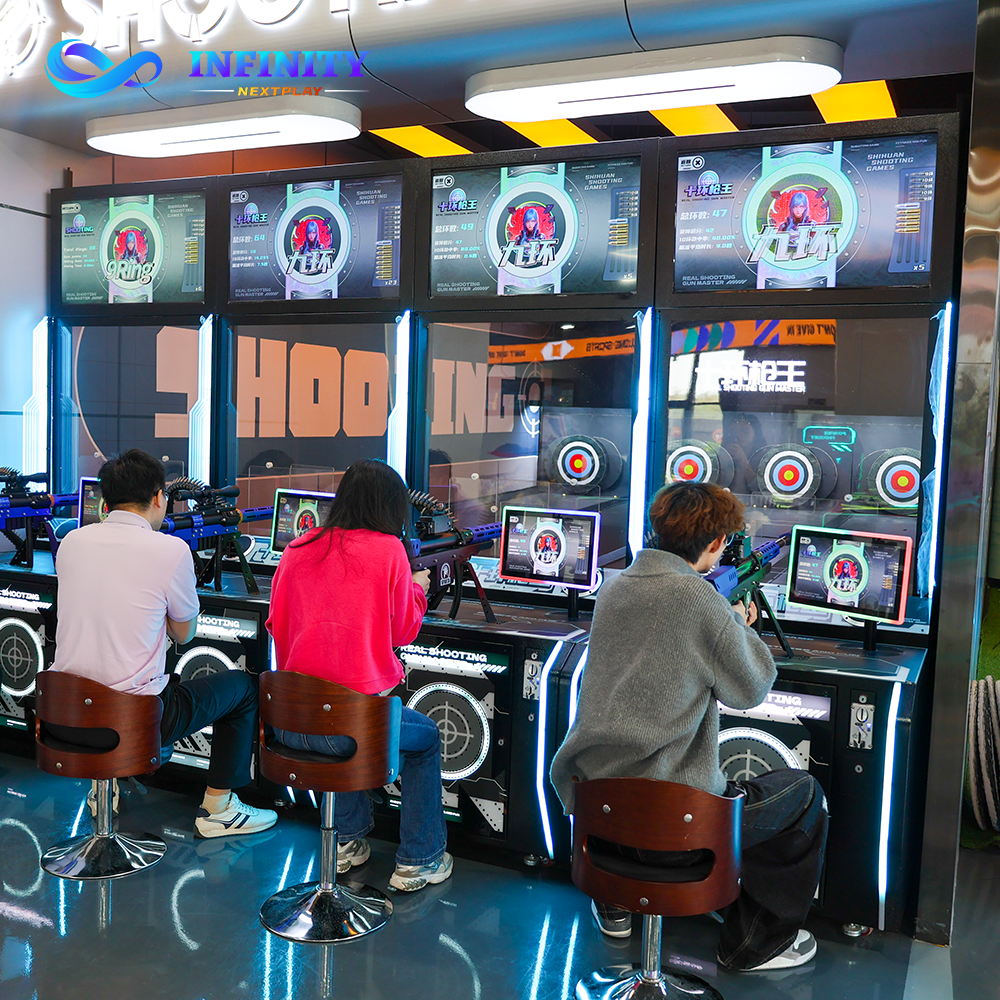
The Shooting Master Q4 is built for exactly the model I am describing. It uses rubber-bullet self-loading action with moving targets, which means the recoil and target movement replicate real range conditions without the regulatory overhead of a live-fire facility. The digital scoring system runs a real-time leaderboard with rewards built into the firmware, which is what makes the league format work. You can show a member their hit-rate consistency, their reaction time and their handicap-adjusted rank with two taps. That is not a gimmick. That is the entire reason they pay $349 a month instead of $25 a session at a static indoor range.
Rubber-bullet self-loading, moving targets, real-time leaderboard with rewards. The unit that turns a back room into a paid training facility.
View Details →In the Los Angeles room I run two Q4 units side by side along the back wall, taking up about 260 sq ft total including the shooting line clearance and the ballistic partition. That leaves the front of the room for the archery simulator, a small bar and a single duckpin lane. The math works because the Q4 is genuinely multi-user: members can rotate in every 25 minutes during peak, and the system enforces the rotation automatically with the leaderboard. You are not paying a floor manager to babysit the queue.
Diego is a 40-year-old former Marine Corps marksmanship instructor who got out of the service in 2022, took his savings and a small SBA loan, and leased a 3,500 sq ft second-floor space in Glendale for $7,500 a month. The space had been a failed CrossFit box, which meant the floor was already rubberized and the bathroom plumbing was in place. That saved him about $22,000 in build-out.
His total capital stack looked like this:
| Category | Item | Cost (USD) |
|---|---|---|
| Equipment | 2 × Shooting Master Q4 (rubber-bullet, leaderboard) | $18,400 |
| Equipment | 1 × Archery Simulator A4 (dual display, adjustable track) | $6,800 |
| Equipment | 1 × Duckpin lane (string, 2-lane compact) | $13,500 |
| Build-out | Ballistic partition, lighting, sound, ventilation | $16,200 |
| Build-out | Bar build, millwork, seating, lockers, pro shop | $14,800 |
| Systems | POS, membership software, CCTV, Wi-Fi, A/V | $7,300 |
| Inventory | Rubber bullets, arrows, replacement parts, F&B | $5,000 |
| Working capital | 3 months operating reserve | $3,000 |
| Total Capex | $85,000 | |
The most important number on that table is not the $85,000 total. It is the $16,200 in ballistic partition and ventilation. Diego spent that money specifically to make the shooting area sound-isolated from the archery area and the social floor. Without that wall, the cross-noise destroys the coaching experience on the A4. Members who are paying for an archery session do not want to hear the rhythmic thwack of rubber bullets hitting the backstop 50 feet away. Get the partition right or do not bother opening.
His monthly P&L after 16 months of operation, stabilized:
| Revenue Line | Monthly | % of Total |
|---|---|---|
| Training Packages (1-on-1 + group + corporate) | $9,625 | 45.8% |
| All-Access Memberships (35 × $199) | $6,965 | 33.2% |
| Elite Memberships (5 × $349) | $1,745 | 8.3% |
| Private Events (avg 2/month × $1,260) | $2,520 | 12.0% |
| F&B Upsell (members + guests) | $1,180 | 5.6% |
| Walk-in Lane Rental (non-member archery) | $65 | 0.3% |
| Total Revenue | $22,100 | 100% |
Wait, that adds up to $22,100, not $21,000. The difference is seasonality. Diego runs about 55 active members on average, but in any given month there are 3-5 training packages that go un-booked because of cancellations, plus the F&B line dips during the post-holiday slump in January. The real stabilized number lands between $20,500 and $22,800. I rounded to $21,000 in the headline because that is the worst-month floor, not the best-month ceiling. Plan for the floor.
After rent ($7,500), labor for two part-time floor staff plus a weekend bartender ($5,500), utilities and liability insurance ($1,800), and inventory restocking plus software subscriptions ($1,200), his net profit lands at roughly $5,000-$5,500 per month depending on the season. The payback on $85K capex is 15-17 months at that net profit. That is faster than most small-venue entertainment concepts, and the reason is the training package line. Most operators do not have that line item. They sell memberships and hope. Diego sells a $95 personal session and a $195 group session, and those transactions are the highest-margin thing in the room.
The archery simulator was the gamble. Shooters are easy to find in Los Angeles. People who will pay to practice archery indoors on a Tuesday night are harder to find. But heres the insight: serious archers in LA used to drive 50 minutes to the nearest outdoor range in Burbank, pay $30 range fees, and shoot at static targets in 95-degree heat. Diego offers them a climate-controlled, well-lit simulator with adjustable track distance, dual-screen scoring, league integration and a bar upstairs, for $199 a month unlimited. They signed up. All 12 of his serious archer slots were filled in the first four weeks.
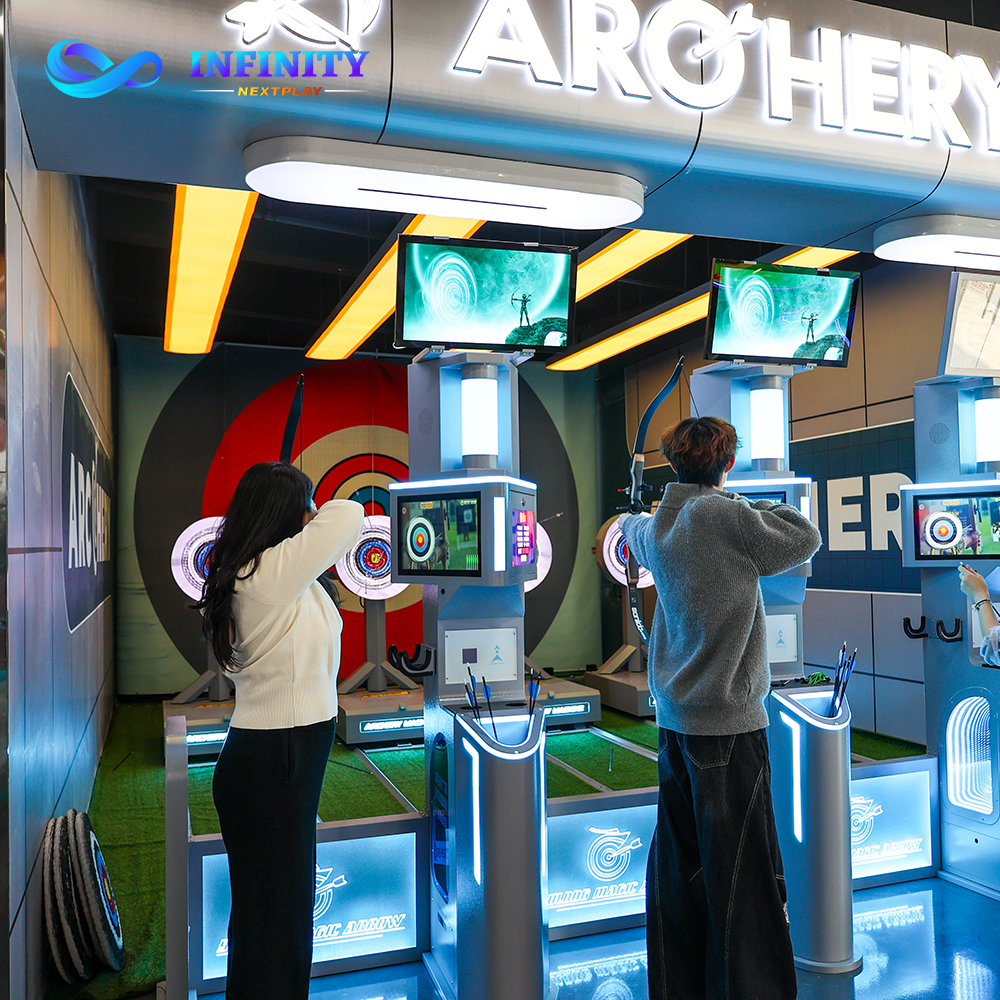
The Archery Simulator A4 is the only piece of equipment in the room that genuinely cannot be replaced by a cheaper analog. A foam target butt in the corner costs $200 and gets used twice. The A4 has adjustable track distance (which means a 20-yard shot and a 40-yard shot in the same 12-foot lane), dual-display scoring and a built-in handicap system that lets a beginner shoot against a tournament archer. That handicap system is what makes the league format work, and the league format is what retains members month over month.
Adjustable track distance, dual display, handicap-adjusted league mode. The coaching anchor that turns a hobby into a paid training program.
View Details →A common mistake operators make is treating the A4 as a "fun extra". It is not. It is the differentiator. There are 8 indoor shooting ranges within 30 minutes of Diegos location. There are zero other indoor archery simulators with league infrastructure in the same radius. The A4 is the reason members choose his complex over a cheaper shooting-only alternative. Price the membership to reflect that. $199 is not a discount on shooting. It is a premium for shooting plus archery plus a place that feels like a club.
One critical operational note: the A4 needs a 14-foot clearance behind the shooting line and a 10-foot side clearance for the bow arm. Do not cram it into a corner. Diego lost five weeks of revenue because the original placement violated the side clearance and he had to move it after the first inspection. Read the spec sheet twice before you sign the lease on the space.
Sofie is a 35-year-old interior designer who pivoted into hospitality in 2023. She opened her multi-sport training studio in a 3,000 sq ft ground-floor space in Amsterdam Noord, across the IJ from the central station, for EUR 4,800 ($5,200) per month. The space had been a failed climbing gym, which meant the ceiling was 14 feet and the floor was already impact-rated. That saved her about EUR 25,000 in build-out.
Her revenue mix is different from Diegos and worth studying:
| Revenue Line | Monthly (EUR) | USD Equivalent |
|---|---|---|
| Memberships (42 × EUR 249) | EUR 10,458 | $11,500 |
| Corporate Team Sessions (4/month × EUR 480) | EUR 1,920 | $2,110 |
| Personal Training Sessions (20 × EUR 95) | EUR 1,900 | $2,090 |
| F&B (Dutch beer + bitterballen upsell) | EUR 1,050 | $1,155 |
| Walk-in Lane Rental (lunchtime corporate) | EUR 150 | $165 |
| Total Revenue | EUR 15,478 | $17,020 |
Sofies revenue is lower than Diegos in absolute terms, but her operating costs are also lower: rent is EUR 4,800 ($5,200), staff is EUR 3,400 ($3,740), and utilities plus inventory come in around EUR 1,500 ($1,650). Her net profit is EUR 5,778 ($6,360) per month, which gives a 14-month payback on EUR 80K. Faster than Diego, actually, because she has lower rent and she negotiated a 6-month rent-free period as part of her build-out agreement. That is a common lease concession in Amsterdam Noord right now because the area is still gentrifying.
The lesson is not that one city is better than the other. The lesson is that the same three pieces of equipment, sized and priced correctly, work in two completely different markets. The model is portable. Your job is to find the right 3,000-3,500 sq ft space in a city where 40-55 adults will pay a premium to train at a skill indoors.
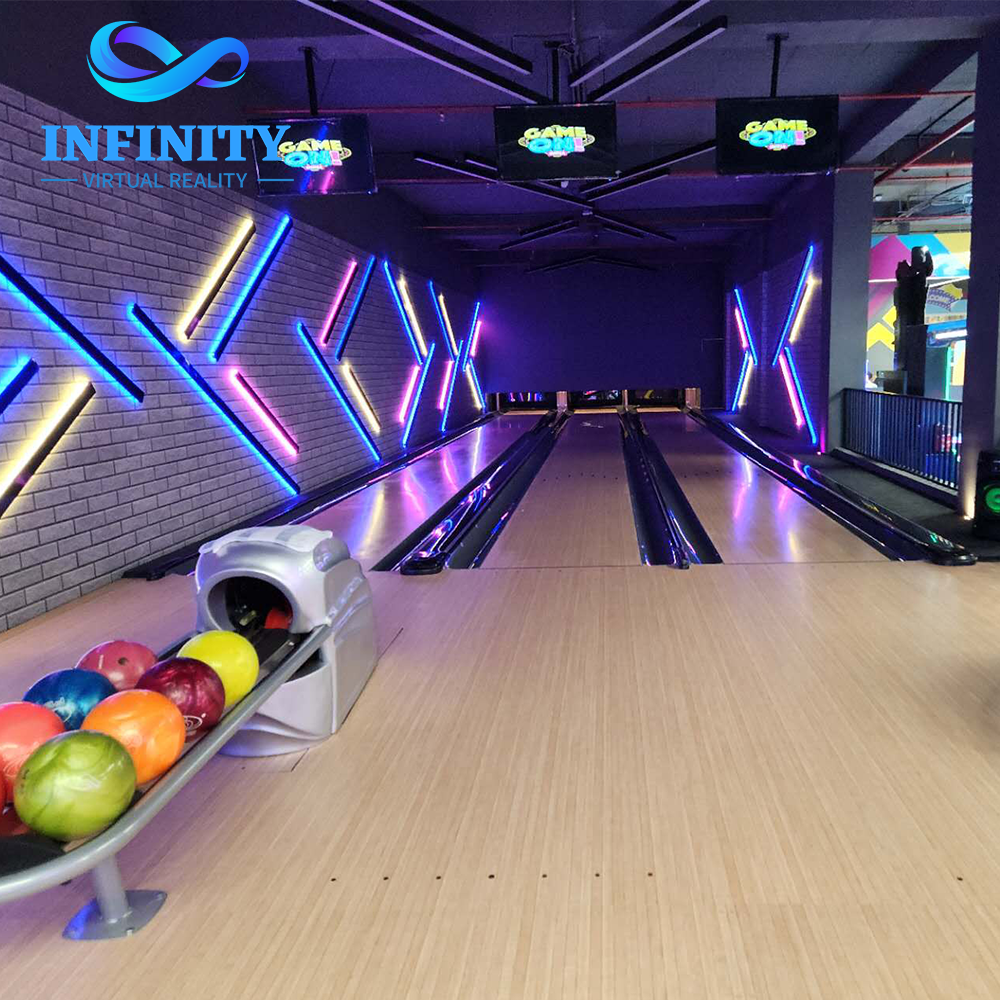
The Duckpin lane is the piece operators most often skip in a training-focused concept. The argument goes: "I am running a serious training facility, why do I need a bowling lane?" The answer is recovery. Shooters and archers train hard. They spend 60-90 minutes in intense focused practice, and after that they need to decompress. The Duckpin lane is the decompression. Without it, members finish their session, pack up and leave. With it, they finish their session, grab a beer, bowl a casual game and stay another hour. That extra hour is when they invite a friend, and that friend is your next member.
Diego added the Duckpin lane four months after opening. His membership grew from 38 to 55 in the five months following the install. Was the lane the only reason? No. But it was the reason members started treating the complex as a Friday-night destination instead of a Wednesday-evening practice room. The lane generates about $1,200 a month in non-member walk-in revenue, plus it is the single biggest contributor to private event bookings. Nobody books a "shooting party". They book a "team building night with shooting, archery and bowling". The bowling is what makes the event pitch work.
Compact 2-lane string design, easy install. The recovery anchor that turns a training room into a destination.
View Details →The Duckpin system Diego uses is the compact 2-lane string design. String pinsetters are quieter than free-fall, which matters in a small room with an active shooting area 40 feet away. The total footprint is 22 feet by 6 feet, and the install took three days. If your ceiling is under 9 feet, do not bother. The pinsetter needs clearance. Check that before you commit to a lease.
Before we get into the operating model, here is the side-by-side comparison of the three pieces of equipment I am recommending. Each one fills a different role in the training complex. Do not skip any of them.
| Attribute | Shooting Q4 | Archery A4 | Duckpin (string) |
|---|---|---|---|
| Role | Volume driver | Differentiator | Recovery anchor |
| Approx unit cost | $9,200 | $6,800 | $13,500 (2-lane) |
| Footprint | 10 ft × 14 ft | 14 ft × 12 ft | 22 ft × 6 ft |
| Ceiling min | 9 ft | 9 ft | 9 ft |
| Users/hr capacity | 4 | 2 | 4-6 |
| Card-reader | Via POS integration | Via POS integration | Via POS integration |
| League software | Built-in (leaderboard) | Built-in | External |
| Maintenance/yr | $800 | $500 | $1,200 |
| Revenue contribution | 40-50% | 25-30% | 15-20% |
| Replacement cycle | 7-10 yrs | 7-10 yrs | 12-15 yrs |
The pattern here is intentional. The Q4 is your highest-revenue-per-square-foot unit because four members can rotate through per hour and the personal training packages attach directly to it. The A4 has lower throughput but commands a premium membership tier, which is where the real margin sits. Duckpin has the lowest direct revenue contribution but is the reason your members renew. Without the lane, you are a training facility. With the lane, you are a club.
This is the part where most blog posts go vague. I am going to give you the actual sequence I would follow if I were opening a training complex tomorrow, based on what Diego and Sofie both did right and the mistakes they made.
Do not chase premium foot-traffic locations. You are not a coffee shop. Members will drive 30 minutes to a training complex if the room is right. Look for second-floor or back-of-building commercial space in light industrial or mixed-use zones, with 9-foot minimum ceilings, existing bathroom plumbing and a noise tolerance clause in the lease. The lease should explicitly permit "amusement equipment operation including rubber-bullet shooting simulators". Get that clause added if it is not in the standard form. Diego spent three extra weeks negotiating that clause and it saved him from a noise complaint lawsuit in month six.
Budget 10-14 weeks of build-out time before opening. Floor leveling, ballistic partition between the shooting and archery zones, ventilation and sound isolation are the four things that always take longer than the contractor quotes. Do not sign a lease that requires you to be open in 30 days.
Order the Shooting Q4 first. Lead time is typically 5-7 weeks, and you can install and test it before the room is fully finished. Order the Archery A4 second. The Duckpin string lane can be ordered last because the install is a 3-day on-site job and the lead time is the shortest of the three.
Total equipment capex target: $35,000-$40,000 for two Q4s, one A4 and a single 2-lane Duckpin. If you have to cut something, cut the second Q4, not the A4. The A4 is the differentiator. The second Q4 is incremental volume.
A common mistake is pricing the membership at $99 because "I want it to be accessible". That is the wrong instinct. At $99 you need 200 members to hit $20K/month revenue, and 200 members will overcrowd a 3,500 sq ft room. At $199 you need 50 members, and 50 members never feel crowded. The premium price point is itself a feature. Members self-select for seriousness, and serious members are the ones who renew at 90%+ rates.
But the real money is in training packages. Structure your pricing in three layers:
Diegos distribution is roughly 50 personal sessions, 25 group sessions and 4 corporate sessions per month. That is $9,625 in training revenue alone, before any membership revenue. The memberships are the recurring base. The training packages are the growth engine.
The single biggest membership retention lever is the league structure. Do not wait until you have 40 members to launch a league. Launch a 12-person shooting league in week two with 8 paid members and 4 walk-ins. The walk-ins will convert to members within a month because league nights are the most fun thing in the room. The A4 has built-in league software with handicap adjustment, so a beginner can compete against a tournament archer and have a chance. Use it. Charge a $35 league entry fee per season, separate from membership.
Run three leagues: Tuesday Shooting (12 weeks), Wednesday Archery (8 weeks), Friday Mixed Duckpin (10 weeks). The Friday league is the one that brings guests. Guests are the ones who become members. The flywheel is: members invite guests to Friday league, guests sign up as members within 30 days, new members invite more guests. Without the league structure, you are running a training facility. With it, you are running a club.
Sofies Amsterdam location does EUR 1,920/month in corporate team sessions. Diegos Los Angeles location does $760 in this line because he never built it. The mistake is real. Daytime hours from 11am to 4pm are dead in a training complex. Members are at work. The room sits empty. Corporate sessions at $480-$1,200 per booking fill that dead time with zero marginal cost.
To win corporate sessions, you need three things: a corporate-friendly booking page, a fixed 90-minute session format and a non-alcoholic beverage package. Most HR departments will not approve an event where the headline activity is "drinks". They will approve an event where the headline activity is "team shooting and archery coaching with optional social hour after". Frame it correctly and the bookings come in.
Q1: How much does it cost to open a training complex?
Total capex lands between $75,000 and $95,000 depending on build-out condition. Equipment is $35K-$40K. Build-out is $20K-$35K. Systems and working capital are $10K-$20K. If a landlord hands you a vanilla shell, expect to be at the top of that range. If you take over a failed fitness studio with existing bathrooms and rubberized floors, expect the bottom.
Q2: Can I run this without hiring a full-time coach?
Yes, but only if you use the equipment correctly. The Shooting Q4 has built-in coaching modes with target patterns and progress tracking. The Archery A4 has adjustable track distance and on-screen coaching overlays. Members can self-coach using the saved session history. You will still need a part-time floor staff person who knows the games, but you do not need a certified instructor on payroll. The personal training sessions can be delivered by a contracted coach who comes in 12 hours per week. That is the Sofie model and it works.
Q3: What is the typical member retention rate?
After the first 90 days, retention stabilizes at 85-90% monthly. The first 90 days are brutal: about 25% of new members cancel within 3 months because they thought they wanted to train and then did not. Price the membership high enough that those people do not sign up in the first place. The $199 price point filters them out before they ever set foot in the room.
Q4: How do I handle peak hours when members all want lane time?
Reservation system, mandatory. Every member gets 4 peak-hour reservations per week, bookable 7 days in advance. Walk-in lane time is only available if no reservation is holding the slot. This sounds restrictive but it is the only way to make 50 members feel like the room is theirs. Without reservations, the room feels crowded by month three and churn starts in month four.
Q5: Should I serve alcohol in a training complex?
Depends on your jurisdiction and your liability tolerance. Diego serves beer and wine, no spirits, and only after 5pm. Sofie serves Dutch beer and wine, also after 5pm. Both have liquor liability insurance, which adds about $1,200/year to operating cost. The F&B margin on a single beer is 75%, which is why the F&B line in both P&Ls looks small but contributes disproportionately to net profit. If your local license process is brutal, skip alcohol and run a coffee/tea bar. The model still works, just slower to payback.
Q6: What is the biggest reason a training complex fails?
Two reasons, equally common. First, pricing too low and trying to compete with arcades on volume. The model only works if you treat it as a premium training facility with a social floor, not an arcade with some training equipment. Operators who price at $99/month invariably fail because they need 200 members to break even, the room gets crowded and the serious members leave. Second, skipping the ballistic partition to save $5,000 on build-out. Without that partition, the cross-noise between shooting and archery destroys the coaching experience, members complain, and you spend six months retrofitting a wall you should have built in week one. Hold the price at $199+ and build the wall.
If you follow the formula above, here is what the 24-month outlook actually looks like. This is not the optimistic version. This is the version that accounts for slow months, equipment repairs and the membership churn that always happens in months 6-9.
| Month | Members | Revenue | Net Profit | Cumulative Capex Recovery |
|---|---|---|---|---|
| 3 | 22 | $8,400 | -$3,600 | $0 |
| 6 | 34 | $12,900 | -$1,000 | $0 |
| 9 | 45 | $17,200 | $2,400 | $7,200 |
| 12 | 52 | $20,100 | $4,800 | $21,600 |
| 15 | 54 | $20,800 | $5,200 | $37,200 |
| 18 | 55 | $21,000 | $5,400 | $53,400 |
| 21 | 55 | $21,300 | $5,600 | $70,200 |
| 24 | 58 | $22,100 | $5,900 | $87,900 |
| Break-even on $85K | ~55 | ~$21K | ~$5.4K | Month 17-18 |
That is the real curve. You will be cash-flow negative for the first 6-7 months. You will cross into net profitability somewhere around month 8-9. You will not recoup the full $85K until month 17-18. That is faster than most small-venue entertainment concepts because the training package line accelerates the curve, but it is still not a 12-month payback. Anyone who tells you a small entertainment venue pays back in 12 months is lying or operating in an anomaly market. Plan for 18-24 months and you will not be surprised.
The good news is that once you cross the breakeven point, the marginal cost of adding the next 10 members is almost zero. Your equipment is paid off. Your staff is already on payroll. Your rent is fixed. Every incremental member after breakeven drops 70-80% to the bottom line. That is why the training complex model rewards patient operators and punishes impatient ones.
Get a free 3D layout for your space. No commitment required.
The training complex model works in 2026 because it sits at the intersection of three trends that are not going away: adults want to learn skills, not just consume entertainment; the price of commercial real estate in secondary zones has softened enough that 3,500 sq ft leases are affordable again; and the equipment has finally gotten good enough that you can deliver a coaching-grade experience without hiring a certified instructor. Five years ago, the Q4 didnt exist in its current form. Ten years ago, the A4 was a $40,000 prototype. Today, both are off-the-shelf, ship in 5-7 weeks and integrate with off-the-shelf membership software.
If you are sitting on a lease decision right now, my advice is this: pick the 3,500 sq ft space with 9-foot ceilings, the noise tolerance clause and an existing rubberized floor. Order the Q4 and the A4 immediately. Add the Duckpin lane in month four after you have proven the membership demand. Price the training packages at $95 per session and the memberships at $199 minimum, structure your tiers around access patterns, and launch the league in week two. Do all of that, and 18 months from now you will have a room that prints $5,500 a month in net profit and has a 5-month waitlist for new members.
If you want to talk through the specifics of your space, the ceiling height, the ballistic partition, the membership pricing, the league format or anything else, the WhatsApp button above goes straight to me. I read every message and I will not try to sell you anything. The equipment links on this page go to the exact units I have installed in Los Angeles and that Sofie has installed in Amsterdam. If you decide to go a different direction on equipment, that is fine, but at least read the spec sheets so you understand the constraints before you sign a lease.
Good luck. The model works. Just do not price it at $99, and do not skip the partition wall.