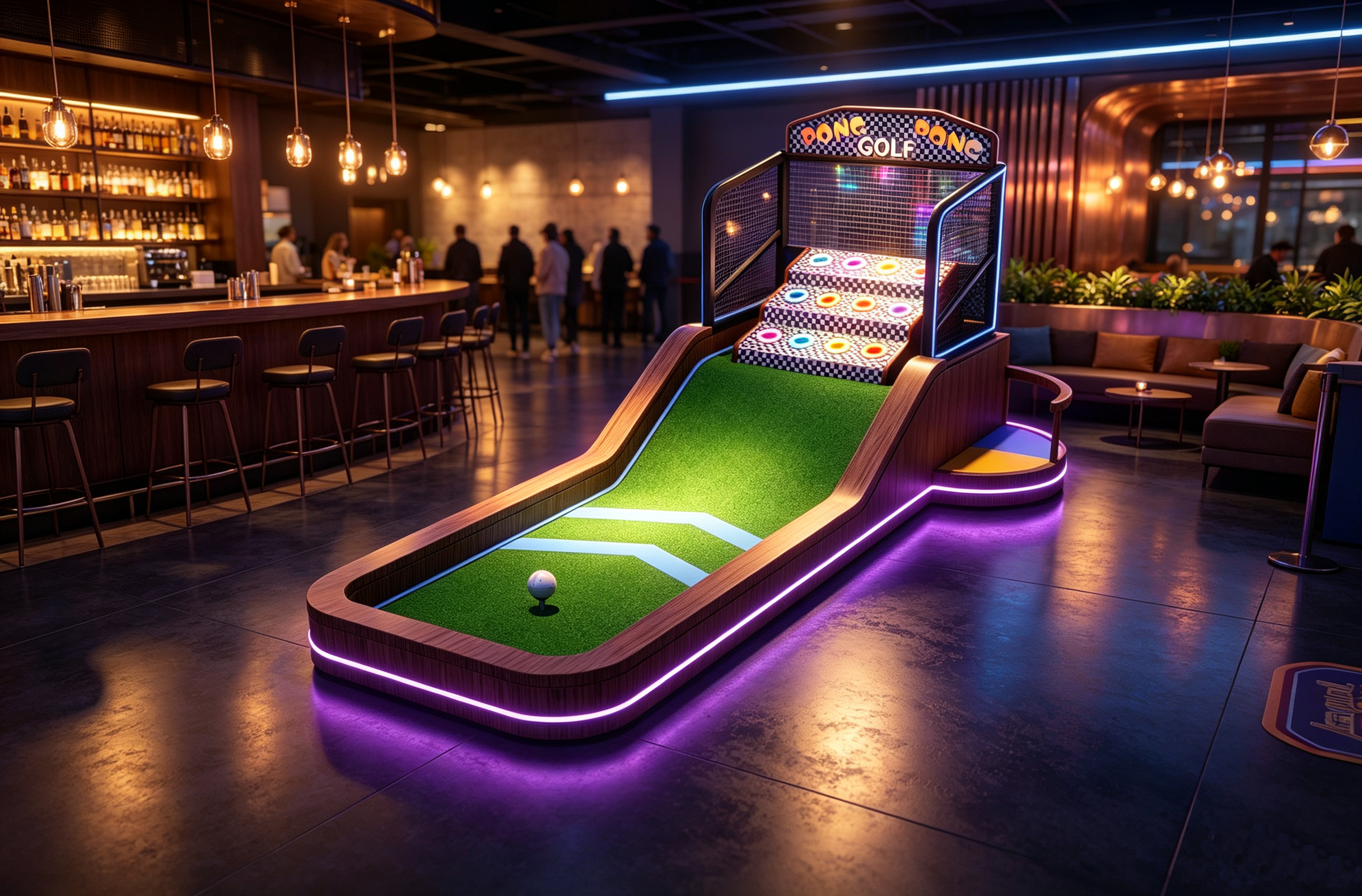
The mini golf round card on published numbers: the $4.50-$9.00 tier band, why the course prices by the round and not the hour, the four-tier daypart structure, the attached value of a round approaching the $12 blend, and the step-by-step card build.
How much should you charge for indoor mini golf? The honest answer is a band with a shape, and the shape has been published. Working rate cards run from $4.50 to $9.00 per round across four daypart tiers - a $4.50 weekday morning tier for schools and seniors, a $5.00 weekday afternoon tier, an $8.00 weekday evening full rate and a $9.00 weekend peak. Venues that print one flat rate converge on $8, and the blended ticket a complete card plus packages produces is about $12 per player. Three numbers, three different questions: what the tiers print, what the flat card prints, and what the mix actually banks.
The three numbers disagree on purpose. The $4.50-$9.00 band is the working structure - the card that moves players into empty dayparts instead of letting them idle. The flat $8 is the walk-up convention - simple to sign, and the reason so many weekday afternoons sit empty. The $12 blend is the outcome - the average the card and the packages jointly produce once product mix, groups and events are in. A venue that copies the $12 blend onto its walk-up sign has read the answer upside down: the blend is made by the card, not printed on it.
| Published reference | Rate | What it measures | Source |
|---|---|---|---|
| Four-tier daypart band | $4.50-$9.00/round | The working tier structure, morning to weekend peak | Rate-card architecture (ue 904) |
| Flat walk-up convention | $8/round | The single-rate card most venues print | Off-peak playbook (ue 637) |
| Weekend peak tier | $9/round | The one block that sells itself | Rate-card architecture (ue 904) |
| Blended ticket | $12/round | Mix average the card + packages produce | Base case (ue 794) |
| Tiered-vs-flat week | $873 vs $800 | 120 tiered rounds vs 100 flat rounds | Off-peak playbook (ue 637) |
| Package value lift | +22-35% | What packaging adds over the flat card | Rate-card architecture (ue 904) |
One boundary keeps the band honest: these are per-round rates for the course itself. Food and beverage, party packages, corporate buyouts and bar-lane rentals all price separately - and the attached-value section shows how far beyond the sticker a round actually runs. A venue reading the $9 weekend tier as a ceiling on the whole customer relationship has misread the card the same way venues misread a walk-up rate as a business model: the round is the floor of the transaction, not the size of it.
The unit is the first pricing decision, and the published record is unanimous: mini golf prices by the round. The reason is what the course actually sells - a completed loop. The scarce asset is a playing slot in the course sequence, consumed by every group that enters and freed only when that group finishes; the clock is irrelevant to the asset, the finished round is everything. That is why the published base case prices a $12 round and counts 120 players per day, and why the capacity work counts players per hour across the loop rather than rental hours.
The contrast with the simulator bay makes the rule sharp, because the neighboring attraction sells the opposite product: the Indoor AR Golf Simulator sells tracked hours of ball-flight data, so its rate card prices the bay per hour and the sibling piece on simulator session pricing reads as a different book. A course that rents itself by the hour has imported a pricing unit from a product it does not sell - and inherited the clock-watching, the overtime disputes and the half-finished rounds that come with it. Price the loop, print the round, and let the daypart tiers do the shaping.
The round unit also explains the exception that proves it: the bar-lane hybrid. A compact 6-9 hole lane beside a bar's floor rents at $45 per hour with an +18% drink attach on the checks it influences - an hour-priced product, because the lane's real business is pacing drinks for a standing group, not completing loops. When the format bends toward hospitality, the unit bends with it; the full lane economics are the bar-formats piece. The course in a proper bay of its own keeps the round.
The single rate card is a lost opportunity printed in one number, and the published four-tier card shows what the shaped version looks like: $4.50 on weekday mornings for schools and seniors, $5.00 on weekday afternoons, the $8.00 full rate on weekday evenings, and $9.00 at weekend peak. The tiers exist because demand is violently uneven across the week, while the cost side is not: the afternoon slot needs the same one-person coverage whether it is empty or full - a published observation that turns every tiered afternoon round into revenue against a cost already paid.
The week math closes the case. A flat $8 rate on a 100-round week earns $800. The four-tier card earns $873 on 120 rounds - the $5 afternoon tier fills forty rounds where the flat card filled twenty, and even at half the price the slot contributes $200 instead of $160 while the players it moved in buy snacks on top. The evening tier on the tiered card earns slightly less than its flat-card equivalent - the published account prices that as the cost of moving twenty weekday players into quiet slots, players who buy snacks and return on weekends. That trade is the whole art of the card.
| Tier (published card) | Rate | The job it does |
|---|---|---|
| Weekday morning (schools & seniors) | $4.50/round | Fill the quietest slot with price-sensitive groups |
| Weekday afternoon | $5.00/round | Convert the empty 40 rounds at the one-person-staffing cost |
| Weekday evening (full rate) | $8.00/round | The walk-up convention, kept honest |
| Weekend peak | $9.00/round | Ration the one block that sells itself |
The card is a living document, and the booking mix tells you when to re-open it. Review at ninety days against the shape the tiers were built to create: an afternoon tier that still sells near nothing is priced too high or paired with no reason to come; a weekend tier turning groups away while weekday evenings sit half-full is underpriced by the distance between your market and the published card. The published inputs for the review are the same ones that built it - the 100-versus-120 round weeks, the one-person staffing line, the $200-versus-$160 afternoon. A card unchanged for six months is a card written for a market someone else opened.
The deeper architecture behind the tiers - tier spacing, the F&B overlay, the package anchors that produce the +22-35% lift - is the rate-card architecture piece, and the original tier playbook that introduced the $5 afternoon is the off-peak work. Both run the same published-anchor method this page applies to the round itself.
The round is the sticker price, not the transaction. The published record attaches three value layers to it. First, food and beverage: the published afternoon player pays $5 for the round and $6 for a snack-bar item - the food share more than doubles the value of the visit on the cheapest slot on the card, which is precisely why the $5 tier exists. Second, product mix: the blended ticket reaches $12 against the $8 walk-up because packages, group formats and peak tiers lift the average - the +22-35% package lift is the published measure of that spread. Third, the group extreme: corporate packages price at $26-36 per guest, six to nine times the walk-up tier, when the course is sold as a hosted block.
The bar-lane benchmark carries the same lesson in miniature: the $45-per-hour lane earns an +18% drink attach on the checks it influences - the attraction is priced as the anchor of a visit, not as the whole visit. The course version of that arithmetic runs through the same F&B counter: every tiered afternoon round drags a snack line behind it that the flat card never sees, because the players the $5 tier moves in are exactly the players with time and appetite to spend. The round is the anchor; the attach is the margin.
| Attached-value line (published) | Value | Source |
|---|---|---|
| Walk-up round (flat convention) | $8 | Off-peak playbook (ue 637) |
| Afternoon round + snack item | $5 + $6 | Off-peak playbook (ue 637) |
| Blended ticket (card + packages) | $12 | Base case (ue 794) |
| Package lift over flat card | +22-35% | Rate-card architecture (ue 904) |
| Corporate package, per guest | $26-36 | Corporate night work (ue 716) |
| Bar-lane drink attach | +18% on $45/hr | Bar formats (ue 854) |
The attached-value lens is also where the hosted-block extreme hands off: a birthday party is not eight rounds - it is a hosted block of course time, room, host and food, and it prices on per-head package math that the walk-up card cannot express. The per-head package arithmetic is the sibling piece on birthday party pricing, and the corporate version of the same block logic - the $4,500 buyout that multiplies a slow evening more than four times - is the corporate night work.
The week math scales to the month, and the scaling is where the tier decision compounds. The published week figures - $800 flat on 100 rounds, $873 tiered on 120 - repeat 4.33 times in an average month, which an EXAMPLE worksheet reads as roughly $3,464 on the flat card against $3,780 on the tiered card: a gap of about $316 a month, or roughly $3,800 across a 52-week year, earned by forty extra rounds on slots whose staffing was already paid. (EXAMPLE multiplication of published week inputs - the week numbers themselves are the anchor, the month is their arithmetic shadow.)
The gap is the budget line for everything the tiered card needs to work: the $4.50 morning price break that brings school groups, the printed per-head arithmetic that sells group formats, and the ninety-day booking-mix review that keeps the tiers honest. A venue that reads the $316 as the cost of running a tiered card has read it backwards - it is the measure of what the flat card leaves on the table every month. The published payback anchor makes the same point at build scale: the $250K build netting $25K a month - payback near ten months - already assumes the utilization the tiers exist to create, and closing the monthly gap is the card doing the job the payback case presumes.
Assemble the card in five steps, each anchored to a published reference rather than a feeling. Step one: set the unit - rounds, always, unless the format is a bar lane. Step two: place the four tiers on the published structure - $4.50 morning, $5.00 afternoon, $8.00 evening, $9.00 weekend - adjusted to your market the way the published cards adjust theirs. Step three: price the attach - a snack menu paced to the round, with the $6-item pattern as the working benchmark. Step four: print the per-group arithmetic, because a group of three or four reads the per-head number, and the per-head number is the bridge to the packages. Step five: diary the ninety-day booking-mix review before you open.
Four card mistakes finish the page, because every one of them appears in the published record of courses that priced wrong. Printing one flat rate forever inherits the empty afternoon - idle floor that the Interactive LED Floor can partially rescue by earning from the waiting groups, but never fully. Copying another town's card imports another town's demand curve. Hiding the per-head arithmetic makes the $9 weekend tier look expensive to the group that would split it without blinking - and the group formats are how the course sells in the first place, from a second compact format like the Beer Pong Golf Hole to the full hosted blocks. And letting packages drift while the card stays fixed breaks the blend: the $12 average is made by the card and the packages moving together, and a card that ignores its packages is a card written for a business it no longer runs.
Two neighboring disciplines close the loop. The revenue totals and ROI cases that this rate card feeds - the $37,440 base case and the utilization ladder above it - are the published cost-space-profit guide, and the payback timeline that turns the card into an investment case is the 300 m2 payback work. The full buying checklist behind the course those rates sell - 18 holes at 300-500 m2, one operator on the Auto-Scoring model - is the same published guide, and the layout behind the tier flow starts from the free 3D layout design.
Start from the published tier band: working cards run $4.50 to $9.00 per round across four daypart tiers, the flat-rate convention is a single $8 round, and the blended ticket a well-run card plus packages produces is about $12. Your position inside the band comes from market, staffing and daypart - the three levers this page works through.
Per round. The course sells completed loops, not clock time - the published base case prices a $12 round and counts players per day, not hours. The hour-priced exception is the bar-lane hybrid, where a compact lane rents at $45 per hour because drink pacing dominates the visit. Simulators are the opposite case: they sell tracked hours, which is why the sibling simulator rate card reads so differently.
The published week math: a flat $8 rate on 100 rounds earns $800, while the four-tier card earns $873 on 120 rounds - the $5 afternoon tier fills forty rounds where the flat card filled twenty at $160. The slot needs the same one-person staffing whether it is empty or full, so every tiered round lands against a cost you already paid.
It is the average revenue per player the whole card produces - tiers, packages and product mix included - not the walk-up rate. The published base case runs 120 players a day at that $12 blend into $37,440 a month of ticket revenue before food, beverage and parties. The walk-up $8 is where the card starts; the blend is what the card is for.
Review the booking mix at ninety days against the daypart fill the tiers were built to create: if the $5 afternoon tier still sells near nothing while the $9 weekend turns groups away, the off-peak rate is too high or the peak rate too low. The full architecture discipline - tier spacing, F&B overlay, package anchors - is the rate-card architecture piece.
Send your market, floor plan and daypart profile and we will return the course specification, the tier-structure check and the layout behind the round card via the free 3D layout design, anchored on the Indoor AR Golf Simulator family.