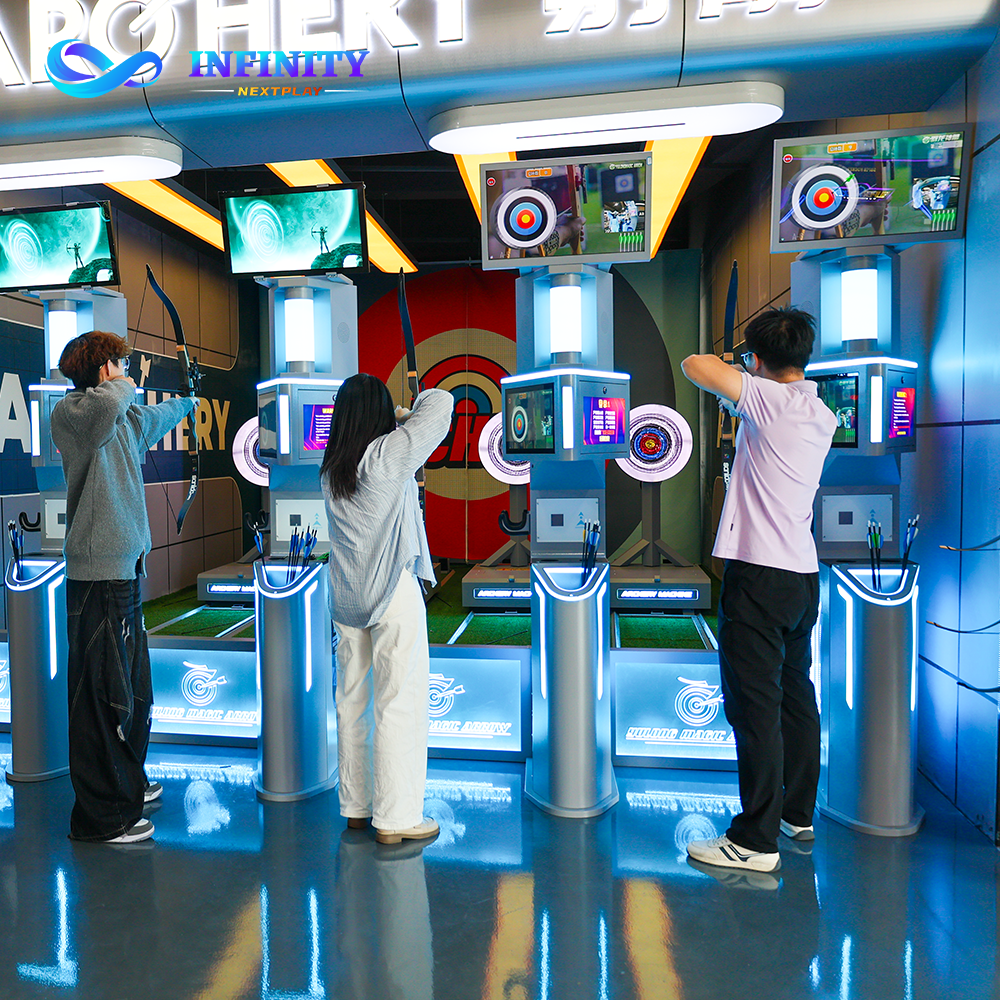
How much does an archery simulator zone cost? If you have priced arcade attractions lately, you know the answer varies wildly depending on who is quoting you and what they are trying to sell. I have helped operators in over 20 countries set up archery simulator zones, and the honest number for a four-lane venue is much lower than most people expect.
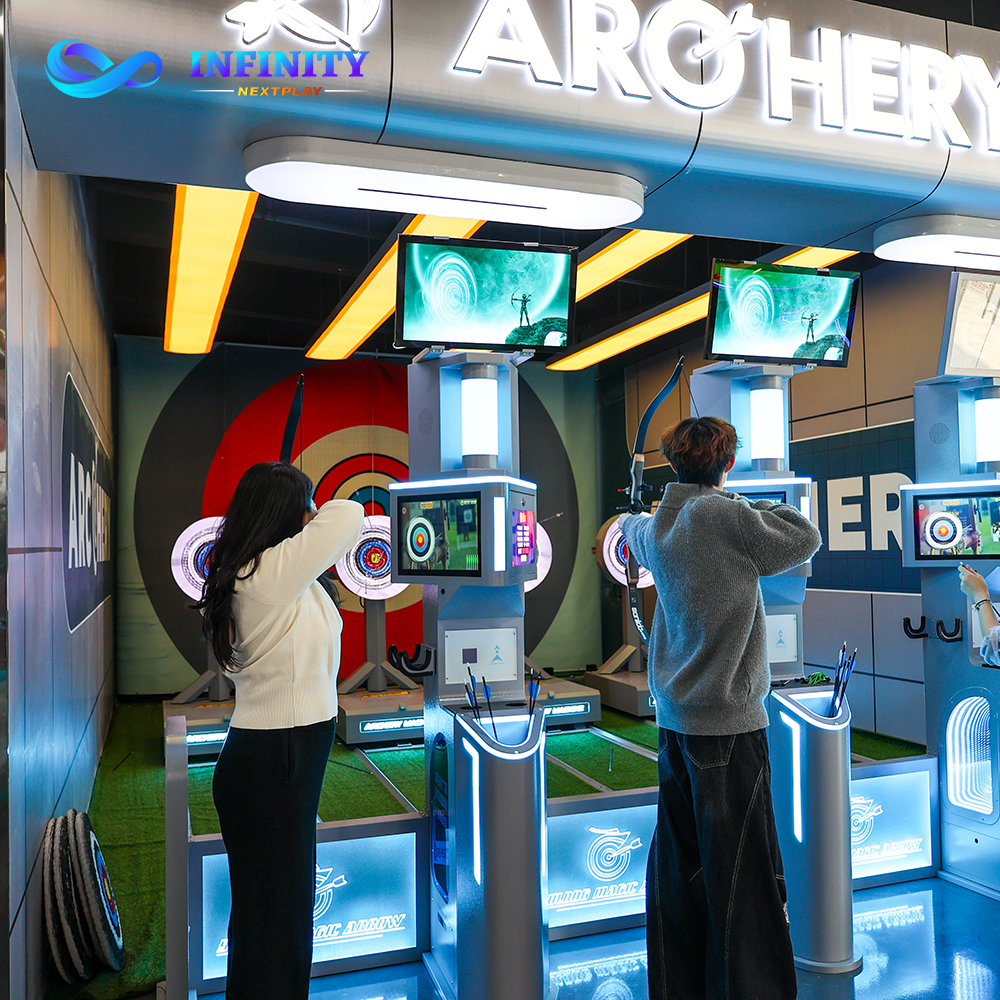
The reason archery works as a venue attraction is that it is both accessible and social. A first-time player can pick up a lightweight bow and hit a target within minutes, while the digital scoring turns every session into a competition. The Archery Simulator A6 adds automatic voice scoring and dual displays, so players hear their score the instant the arrow lands and see their ranking against the room.
This guide walks through the full cost structure, the machine mix that makes sense for your floor, the revenue math behind the 4-6 month payback, and the launch sequence we use with operators. Every figure below is what we see in real projects, not brochure numbers.
Let me break down the real cost of an archery zone the same way I do with every operator before they sign anything. The total depends on three blocks: equipment, fit-out, and working capital. For a 120m2 zone with four archery lanes, one shooting bay, and a counter, the realistic opening budget sits between $42,000 and $68,000.
| Cost Item | Budget Range | Notes |
|---|---|---|
| Archery simulators (4 A6/A4 units) | $24,000 - $36,000 | A6 auto voice scoring for main lanes, A4 for lounge corners |
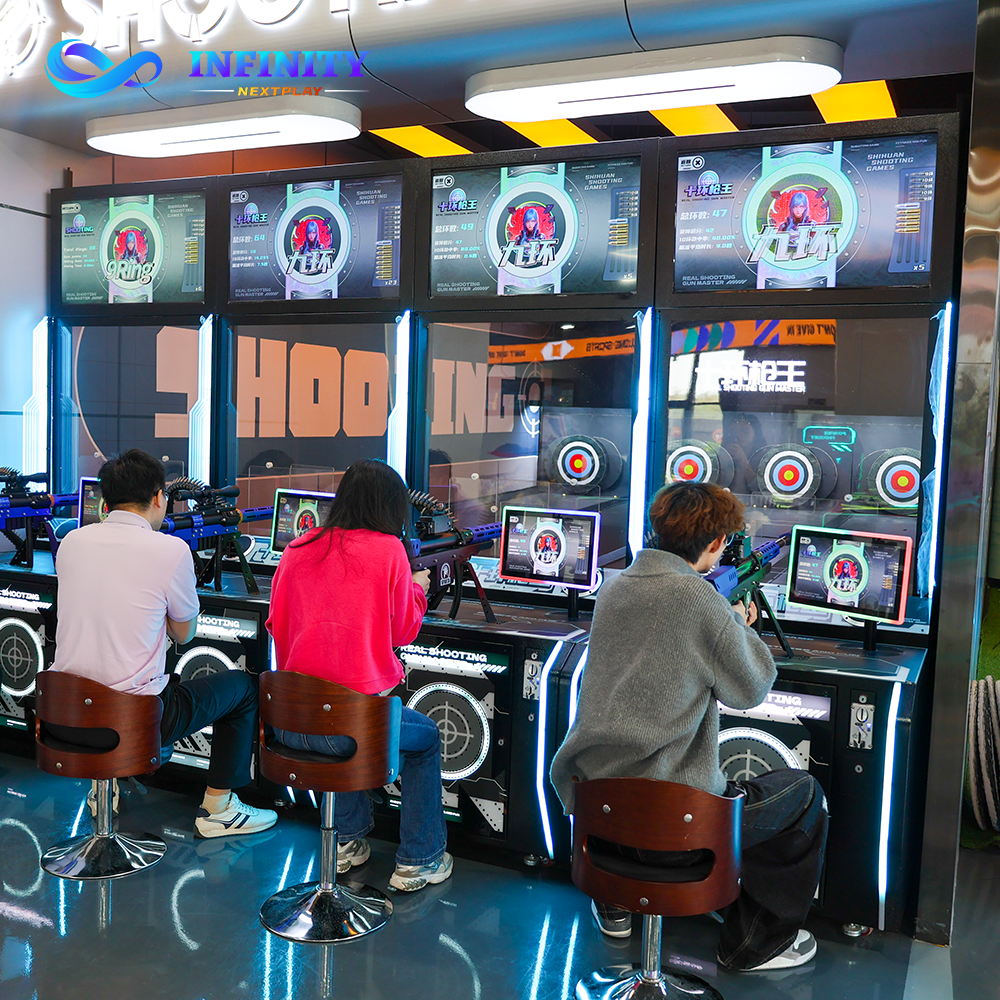
| Shooting bay (1 Q4 simulator) | $6,000 - $9,000 | Cross-category team building anchor |
| Lane barriers and safety mats | $3,500 - $6,000 | Separates lanes, protects walls from arrows |
| Lighting, signage and basic fit-out | $5,000 - $9,000 | LED lane lighting and scoreboard wall |
| Licenses, insurance and deposits | $1,500 - $3,000 | Most venues need no special archery license with simulators |
| Working capital (first 2 months) | $2,000 - $5,000 | Marketing and staff before cash flow turns |
Notice what is not on this list: expensive renovation or a large footprint. Archery simulators use projection screens and optical sensors instead of real arrows, so a zone fits into 100-150m2 and installs in days, not weeks.
If you already own a sports bar or FEC, the incremental cost is just the equipment block: roughly $30,000 to $45,000 for the machines and fit-out, which is exactly why adding archery is one of the highest-ROI upgrades an existing venue can make.
Which archery simulator should you buy? The answer depends on where each machine sits in your venue and what job it does. I recommend a mixed floor: A6 machines for the main lanes where scoring and spectacle matter most, and A4 machines for corners where players gather with drinks.
| Machine | Best For | Key Feature | Price Band |
|---|---|---|---|
| Archery A6 | Main lanes, FECs, amusement parks | Auto voice scoring, dual display | Higher |
| Archery A4 | Sports bars, clubs, lounge corners | Adjustable track distance, dual screen | Mid |
| Shooting Q4 | Team building zone | Real-time leaderboards, rewards | Mid |
The Archery Simulator A6 carries your main lanes: the auto voice scoring calls out each hit, the dual displays show the score instantly, and the arcade format keeps the experience safe for family venues.
The Archery Simulator A4 with adjustable track distance earns its place in the lounge: players adjust the range to match their skill, and the dual screens let spectators watch from the bar, which turns casual drinkers into the next players.
Here is the payback math that makes a four-lane archery zone work in four to six months. This is the conservative model we run with operators, assuming a mid-size city, 120m2, and an average ticket of $12 per person per session.
Total monthly revenue lands around $15,000 to $18,000. Fixed costs (rent $2,800, one part-time attendant $2,200, utilities and software $1,200, maintenance reserve $600) come to roughly $6,800. That leaves $8,000 to $11,000 of monthly profit against an opening investment of $42,000 to $68,000.
The operator I built this model with first was a sports bar owner in Austin who converted a dead storage corner into a three-lane archery zone. He spent $38,000, launched a Tuesday league, and his archery zone was covering its own costs by week 9. His bar revenue on league nights doubled because players booked tables and stayed for food.
Opening an archery zone is not complicated, but the order matters. Here is the 90-day sequence we use with every operator, refined over dozens of launches.
The single biggest mistake new operators make is opening before the league is recruited. An archery zone without a weekly competition is just a room with expensive screens. Start the league conversation the day you sign the lease.
Once the doors are open, retention is everything. The venues that last build a weekly rhythm around the machines, not a one-off novelty. Here is what the operators I work with actually do to keep players coming back.
League players spend 2 to 3 hours in the venue per visit, versus 45 minutes for a walk-in player. That dwell time is where drink revenue compounds, and it is the reason archery zones trade at higher multiples than standard arcade rooms when they eventually sell.
A 120m2 zone with four archery lanes, one shooting bay and a counter opens for $42,000 to $68,000 including fit-out, licensing and working capital. Adding archery to an existing venue costs only the equipment block: $30,000 to $45,000.
Commercial archery simulators range from roughly $5,500 for an A4 lounge model to $7,500-$8,500 for an A6 auto voice scoring model. Volume orders of 4 or more lanes bring the per-machine price down.
Archery zones earn from per-session game fees, weekly league entries, weekend group bookings, and high-margin drink sales. A four-lane venue typically generates $15,000 to $18,000 per month in revenue.
With a league program running from week one, operators reach payback in 4 to 6 months on the equipment investment and 9 to 12 months on the full fit-out. The machine mix pays for itself before the lease does.
Start with 3 to 4 lanes depending on floor space. A 120m2 venue supports 4: two A6 main lanes and two A4 lounge lanes, plus one shooting bay for group bookings.
Not strictly, but leagues are what separate a profitable archery zone from a room with expensive screens. League players visit weekly, book tables, and drive drink revenue. Recruit your first 12-16 players before opening day.
Ask NextPlay for an archery zone proposal: 3D floor CAD drawings, A6 vs A4 machine selection with pricing, and a payback model tailored to your venue and target market.