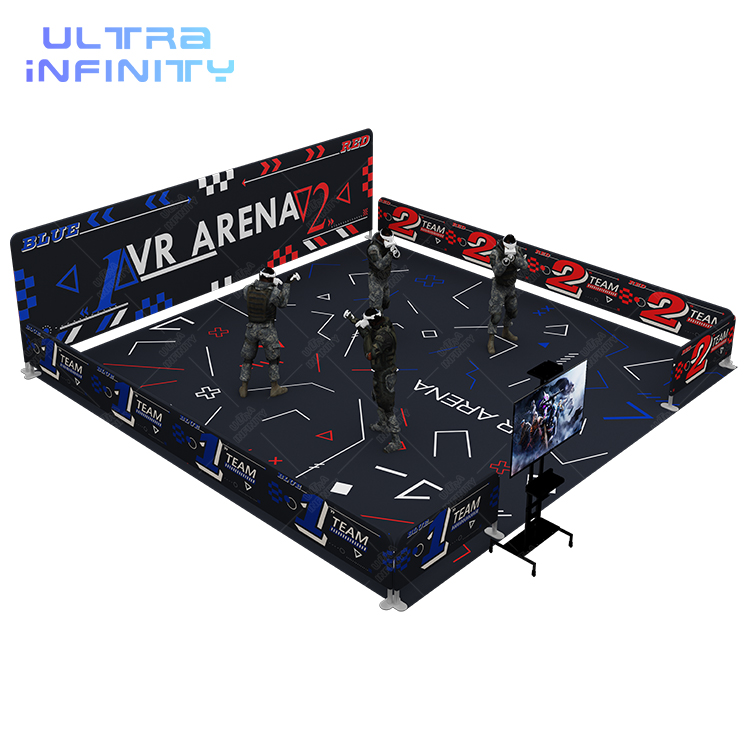
Most location-based VR is a seated or tethered experience. A player puts on a headset, stands on a small pad, and swings at nothing while the outside world watches a flat screen. Free Roaming VR Arena 2.0 removes every one of those limits. Players walk on a real floor, ten meters or more from wall to wall, wearing a wireless headset and a lightweight vest. They see teammates. They hear footsteps behind them. They physically duck, sprint and take cover. The result feels less like a video game and more like stepping inside one.
For a venue operator this difference is the entire business case. A free-roam arena is a spectator event as much as a player event. Friends gather around the glass, cheer, record, and form the next squad. That social gravity is what drives repeat visits, group bookings and the kind of organic word-of-mouth that paid acquisition can never buy. When a guest leaves and immediately texts three friends to come try it, you have a growth loop that costs you nothing to run.
The product launched in December 2023 and has since been installed across family entertainment centers, arcades, shopping-mall pop-ups, hotels and corporate team-building spaces. The reasons operators choose it again and again come down to three engineering decisions we refused to compromise on, and to a content model designed for longevity rather than a single launch splash.
These three freedoms compound. Because almost anyone can play, almost any venue can host, and almost any floor plan works, the addressable market for the operator is dramatically wider than a single-format cabinet. A venue that could never justify a heavy simulator can still run an arena. A venue that already has one can add a second without re-engineering the room.
Operators often ask why they should choose free-roam over a cheaper stationary cabinet. The honest answer depends on the role you want VR to play. A stationary cabinet is a solo novelty: one player, one session, little to watch. A free-roam arena is a group spectacle: six players, dozens of spectators, and content worth filming. The revenue per square meter over a full day is not comparable because the utilization profile is not comparable.
Picture a Saturday at a family entertainment center. At ten in the morning a birthday group of ten arrives. Six go in, four watch through the viewing panel, and within ninety seconds the room is laughing as the youngest player lands a trick shot. At one in the afternoon a teenage group books back-to-back sessions because the leaderboard reset overnight. At seven in the evening an adult league runs a structured match with a small crowd and a phone-streamed final round. One room, one system, three completely different audiences, all on the same hardware.
That rhythm is what makes staffing simple. A single host opens the session, fits the gear, runs a ninety-second safety brief, and monitors from the control tablet. Between sessions the room needs a quick wipe of the headsets and a reset of the play area. No technician on site, no complex calibration, no downtime that eats revenue.
A fixed cabinet occupies one person at a time and entertains nobody else. A free-roam arena is the opposite: it is a stage. Consider the operating patterns we see after installation across very different businesses:
The experience is only as good as the hardware beneath it. Every component was selected for commercial duty cycles, not living-room use:
Parents and operators both ask the same question first: is it safe. The answer is built into the design. The play area is a known, bounded space with soft boundaries projected into the game so players never walk into a wall. The vest is padded and balanced for long sessions. Headsets are wiped and sanitized between every group, and the contact surfaces are chosen for easy cleaning under a venue hygiene routine.
Because there is no weight ceiling and no trip hazard from cables, the arena is accessible to a far wider guest list than a tethered rig. Staff training takes minutes, not days, and the control tablet surfaces a live view of every player so a host can pause a session instantly if needed.
The numbers that matter to an owner are simple. Capital cost lands in a predictable band for a six-player arena. With per-session pricing and a realistic occupancy of a few hundred plays per month, the installation typically pays back inside eight to ten months in a healthy venue. After that, the margin is high because the marginal cost of one more session is nearly zero: electricity, a wipe-down, and a short reset.
Beyond direct ticket revenue, the arena lifts the whole floor. Groups that come for VR stay for food, other games and retail. Dwell time rises, and with it the average transaction per visitor. One well-run arena becomes the reason a guest chooses your venue over the competitor across town, and the reason they return the following month with more friends.
Take a mid-size arcade that adds one arena and prices a six-player session at a per-seat rate. If the room averages forty sessions per day at an achievable occupancy, daily ticket revenue alone clears the financing cost within the first year while the floor around it sees a measurable uptick in food and token sales. The exact figures move with local pricing and footfall, but the structure is the same everywhere: high fixed asset, near-zero marginal session, and a strong halo on adjacent spend.
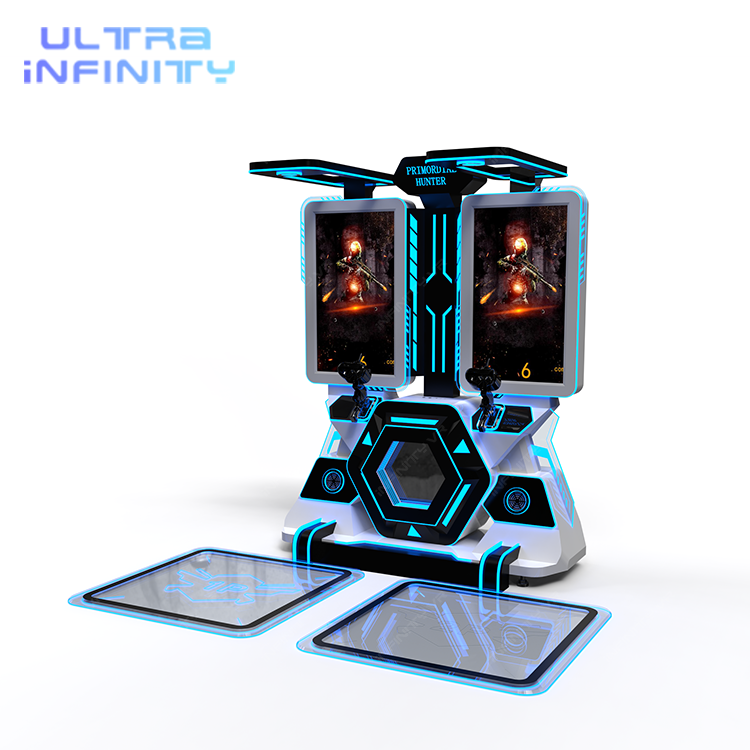
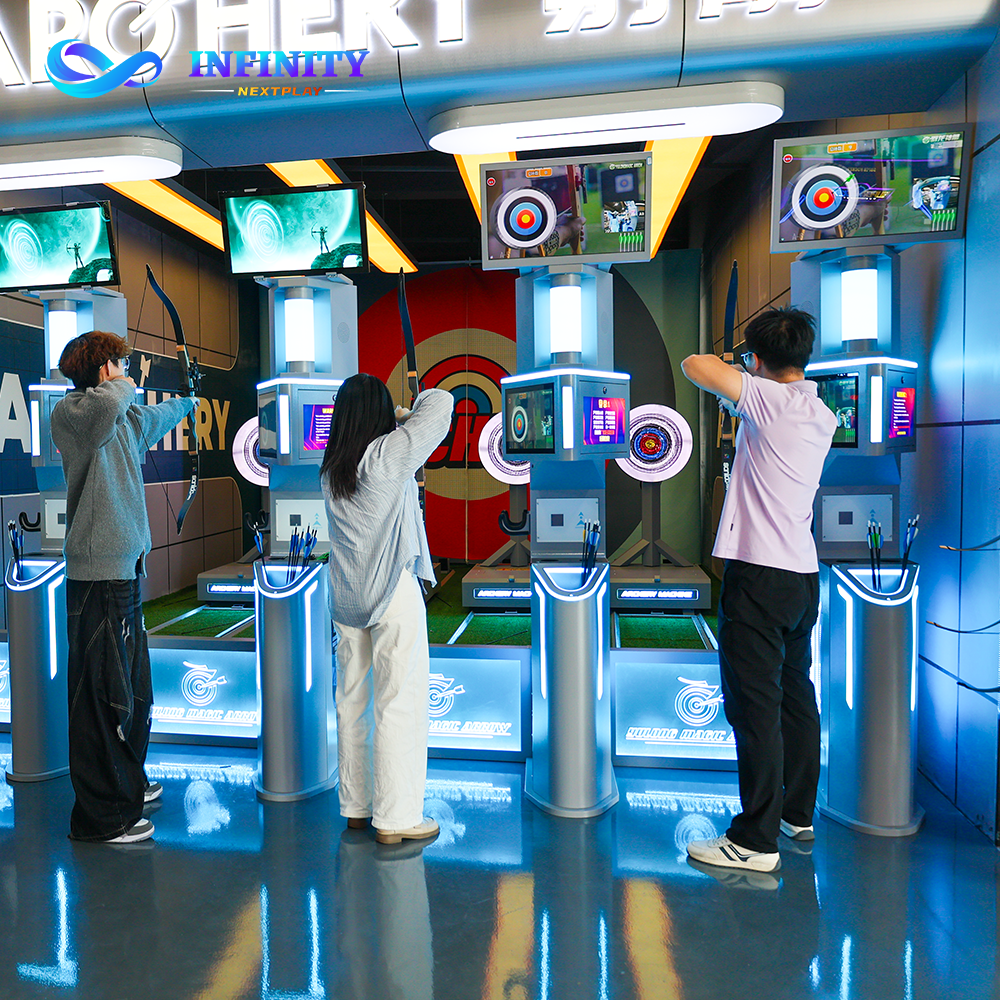
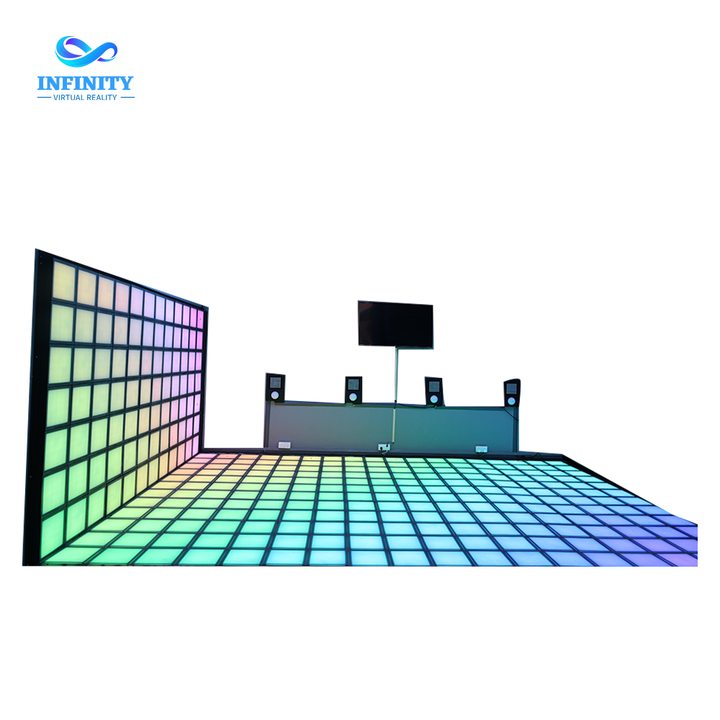
VR Arena 2.0 is strongest as the centerpiece of a broader lineup. The four products below are the ones operators most often pair with it to cover every age and play style, turning a single hero attraction into a complete destination:
An arena sells itself once guests see it, but the venues that win are the ones that fill the calendar on purpose. The patterns that consistently work are straightforward. Run a public leaderboard and reset it weekly so regulars have a reason to return. Offer a group rate for parties and team events. Capture short vertical clips with permission and post them to the venue channel. Bundle the arena with food or other attractions so the ticket feels like a full experience rather than a single ride.
Because the content updates over the air, the marketing story never goes stale. A new map becomes a new reason to visit. A seasonal mode becomes a reason to bring the same group back. That cadence is what turns a launch spike into a durable line item.
A free-roam arena lives or dies by its content. We ship a rotating library rather than a single canned scenario, so the floor stays interesting across repeat visits and regulars always have a reason to return.
Operators sometimes worry that free-roam means a data center in the back room. It does not. The footprint is closer to a well-equipped game room than a server farm, and most commercial spaces already meet the basics.
The arena is designed to sit beside what you already run. It shares the same ticketing, the same staffing rhythm and the same food-and-beverage flow as the rest of your floor. You do not need a separate building or a separate brand to make it work.
Most operators place it near the entrance as a draw, or in a back hall as a premium zone. Both layouts work; the choice is whether you want it as a magnet for new guests or as a reward for the ones who already came in.
How you sell the session matters as much as the hardware itself. The models we see succeed most often are built around behavior, not just price:
A new host is productive after a single short session. The control tablet guides setup, the safety brief is a fixed script, and the system flags any player who needs attention. No engineering background is required, which keeps labor flexible across your whole team and protects you when someone is out.
Every arena ships with a warranty and a support relationship, not a box and a goodbye. Scenarios arrive over the air, so the content improves after purchase instead of aging in place. When hardware needs attention, remote diagnostics resolve most issues before a visit is even scheduled, which protects your uptime and your revenue.
The decision usually comes down to the boring things that decide whether a floor makes money: reliability, content cadence and support that actually answers the phone.
One operator added an arena to a 2,000 square meter FEC and made it the Friday-night anchor. Within a single season, arena sessions accounted for a disproportionate share of repeat visits, and the surrounding kart and arcade zones saw a measurable lift because guests arrived earlier to book a slot.
The lesson was simple: the arena did not cannibalize other attractions, it staged them. Guests came for the arena and stayed for everything else, which raised the average spend per visit across the whole floor.
A mall partner ran a three-month pop-up in a former retail unit. The arena turned a dead corridor into a destination, lifted footfall to the upper levels, and generated social clips that the mall reused in its own channels. At the end of the term, the unit leased faster because traffic data proved the location could draw a crowd.
For landlords, that is the quiet power of free-roam VR: it is measurable footfall engineering, not just entertainment. The arena pays for itself in tenant interest as much as in ticket sales.
The path is short. We scope your room, propose a layout and pricing, ship and commission the hardware, train your host and hand over a live arena. Most standard rooms open within weeks rather than quarters, and the first sessions can run the same day the install completes.
Safety is designed in, not bolted on. The play boundary is a known, soft space with virtual walls projected into the game so players slow and stop before reaching a real edge. The vest is padded and balanced for long sessions, and the headset weight is distributed so fatigue stays low even in an energetic match.
Because there is no weight ceiling and no trip hazard from cables, the arena welcomes a far wider guest list than a tethered rig. Players who could not use a seated simulator can stand, move and compete. That inclusivity is good ethics and good business, because it widens your addressable audience at no extra cost.
The control tablet is not only a safety tool. It shows session counts, utilization and peaks across the day, so you can staff intelligently and spot the best hours to promote. Over time that data tells you exactly when to run events, when to discount and when to push the league.
A modern arena is efficient. The per-session energy cost is modest, and the hardware is built for commercial duty cycles that run all day without overheating. For operators watching operating cost, the marginal energy of one more session is a rounding error against the ticket price.
Content can be tuned to the audience you actually serve. Language, theme and difficulty can shift for a tourist mall versus a local FEC, and seasonal modes can follow the calendar your guests already celebrate. The result is a floor that feels local rather than imported.
A single cabinet is easy to copy. A free-roam arena with a living content library, a trained host routine and a community leaderboard is much harder for a competitor to match quickly. The moat is operational, not just technological, and it compounds every season you run it well.
Operators who treat the arena as a managed attraction rather than a one-time install tend to see the same arc: a strong launch, a learning curve on packaging, then a steady base of regulars and events that carries the floor. By month twelve the arena is less a novelty and more a dependable revenue pillar.
That is the outcome the design targets. Not a spike that fades, but a system that keeps paying because guests keep coming back for the next match, the next map and the next place on the leaderboard.
Layout decides utilization. We recommend a rectangular clear floor with the control tablet at the entrance corner, headsets stored on a wall rack, and a viewing panel on the long side so a crowd can watch without entering. Keep the play boundary at least one meter from any real wall, and reserve a small reset zone just outside it for the host to brief each group.
If your room is longer than it is wide, orient the map along the long axis so players travel more before meeting. If it is square, use a central pillar or marker as cover. The software adapts the map to the room, so the same hardware feels different in every space, which keeps regulars curious and gives you a reason to rotate the experience.
Free-roam headsets do not need a dark room, but a controlled environment reads as premium. Soft ambient light, a clean floor and a branded wall graphic turn a spare hall into a destination. Sound matters too: a discrete speaker near the host plays the arena audio so spectators feel part of the match without interfering with player headphones.
The host is the difference between a good session and a great one. A short script covers gear fitting, the ninety-second safety brief, and the start sequence. Most new hosts run a confident session after a single shift because the control tablet guides every step and flags any player who needs attention.
You cannot improve what you do not measure. The control tablet surfaces session counts, peak hours and utilization, so you can staff intelligently and promote the right slots. Over a few weeks the pattern is clear: when leagues run, when walk-ins spike, and which days need a discount to fill.
Operators sometimes weigh a free-roam arena against a 9D cinema, a racing sim, or a VR racing pod. Those are solo or small-group novelties with limited spectator pull. The arena is the only one that turns the whole room into a social event, which is why it anchors a floor rather than filling a corner.
From signed order to live sessions, the path is short and predictable. We survey your room, propose a layout matched to your footfall, ship and commission the hardware, and train your host on site. Most standard rooms open within weeks, and the first public sessions can run the same day the install completes, so you start earning before the paint dries.
Talk to Infinity NextPlay commercial engineers about layout, pricing and a rollout plan sized to your floor.