In the highly competitive commercial leisure and amusement industry, Family Entertainment Centers (FECs), shopping center play zones, and modern recreational lounges are constantly seeking ways to capture affluent consumer groups and corporate bookings. Inflation-driven rents, escalating labor overheads, and stagnant weekday traffic often combine to suppress the overall profitability of standard retail spaces. Traditional, low-tech attractions fail to command premium ticket prices, especially among teenagers, young professionals, and tech-savvy family groups. To overcome these commercial limits, premium developers are adopting the "Competitive Socializing" model—a framework that integrates automated, cashless, and highly immersive virtual reality attractions that operate entirely under a self-service model. This comprehensive B2B commercial analysis details how a re-engineered 500m² flagship thrill zone in Madrid achieved an outstanding net passive yield of $48,000 per month. By strategically coordinating three of NextPlay's highest-gensation virtual reality simulators—the 2-Player VR Drop Tower (ID 35), the 5-Player VR UFO Cinema Chair (ID 37), and the 1-Player 360-degree VR Thunder Fighter (ID 34)—the developer completely unlocked their floorplan's earning capacity, achieving direct operating margins exceeding 92% and boosting food and beverage sales by 35%.
In the highly competitive commercial leisure and amusement industry, Family Entertainment Centers (FECs), shopping center play zones, and modern recreational lounges are constantly seeking ways to capture affluent consumer groups and corporate bookings. Inflation-driven rents, escalating labor overheads, and stagnant weekday traffic often combine to suppress the overall profitability of standard retail spaces. Traditional, low-tech attractions fail to command premium ticket prices, especially among teenagers, young professionals, and tech-savvy family groups. To overcome these commercial limits, premium developers are adopting the "Competitive Socializing" model—a framework that integrates automated, cashless, and highly immersive virtual reality attractions that operate entirely under a self-service model. This comprehensive B2B commercial analysis details how a re-engineered 500m² flagship thrill zone in Madrid achieved an outstanding net passive yield of $48,000 per month. By strategically coordinating three of NextPlay's highest-gensation virtual reality simulators—the 2-Player VR Drop Tower (ID 35), the 5-Player VR UFO Cinema Chair (ID 37), and the 1-Player 360-degree VR Thunder Fighter (ID 34)—the developer completely unlocked their floorplan's earning capacity, achieving direct operating margins exceeding 92% and boosting food and beverage sales by 35%.
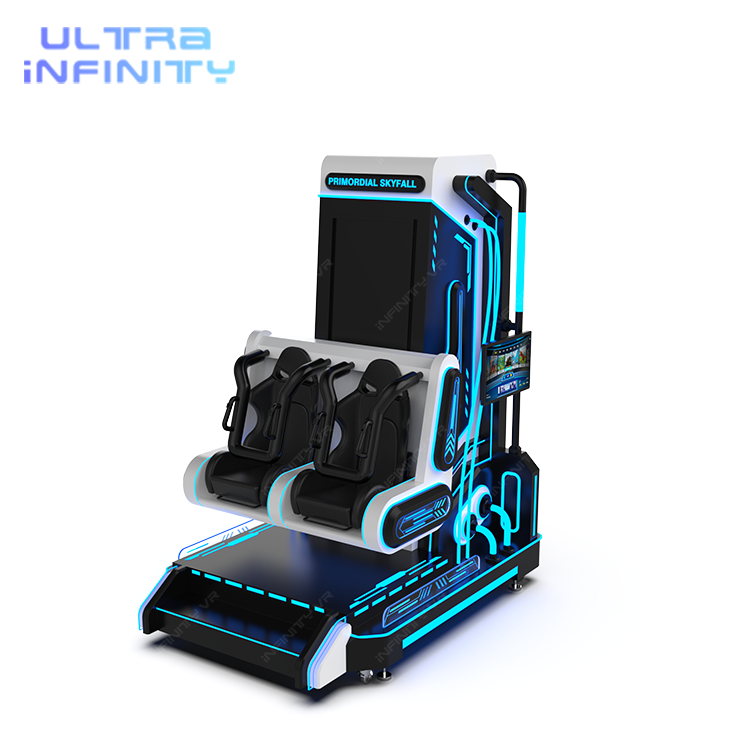
The standout physical attraction and main visual draw of the high-energy thrill zone is the 2-Player VR Drop Tower. While standard mechanical amusement rides require massive ceiling clearance, expensive foundations, and high-voltage power lines, NextPlay's VR Drop Tower delivers a heart-pounding, realistic weightless simulation in an incredibly compact, indoor-friendly modular footprint. Operating on a rigid raised frame with advanced motorized physical lifts, the device recreates the physical sensation of freefall with absolute safety and flawless mechanical precision.
The engineering of the VR Drop Tower is designed specifically for demanding commercial environments. Constructed with high-durability steel-plated frames and secure double-point seat belt restraints, each of the two independent motion seats is driven by advanced brushless synchronous electric drives. The system replicates sudden drops and rapid ascents with micro-second latency, perfectly matching the visual trajectories of the virtual world. The simulator is paired with premium high-definition VR headsets featuring low-latency, protective lenses that prevent motion lag, ensuring an extremely high-gensation experience without causing any motion sickness.
The engineering of the VR Drop Tower is designed specifically for demanding commercial environments. Constructed with high-durability steel-plated frames and secure double-point seat belt restraints, each of the two independent motion seats is driven by advanced brushless synchronous electric drives. The system replicates sudden drops and rapid ascents with micro-second latency, perfectly matching the visual trajectories of the virtual world. The simulator is paired with premium high-definition VR headsets featuring low-latency, protective lenses that prevent motion lag, ensuring an extremely high-gensation experience without causing any motion sickness.
From a business operational standpoint, the VR Drop Tower acts as a pure passive income engine. Operating entirely on a cashless QR-code or RFID member card system, the unit requires zero technical labor or operator overhead. Guests simply scan their mobile devices to deduct play fees, buckle their safety restraints, and initiate the game session entirely via the local touch console. Pre-loaded with over 8 patented NextPlay games, the unit achieves continuous, high-ticket cash flows with virtually zero on-site maintenance, converting compact retail space into a highly profitable play hub.
The standout physical attraction and main visual draw of the high-energy thrill zone is the 2-Player VR Drop Tower. While standard mechanical amusement rides require massive ceiling clearance, expensive foundations, and high-voltage power lines, NextPlay's VR Drop Tower delivers a heart-pounding, realistic weightless simulation in an incredibly compact, indoor-friendly modular footprint. Operating on a rigid raised frame with advanced motorized physical lifts, the device recreates the physical sensation of freefall with absolute safety and flawless mechanical precision.
To complement the high-gensation drop tower and support massive group bookings and family crowds, the venue deployed the flagship 5-Player VR UFO Cinema Chair. Group socializing and shared experiences are the core drivers of long-term customer retention and high repeat visits in FECs. Traditional single-seat VR simulators fail to capture this group dynamic, leaving other members of a party disengaged. NextPlay's VR UFO solves this limitation by packing five independent, highly synchronized motion seats onto a single, high-throughput circular platform.
The engineering of the VR UFO features a rigid, 360-degree horizontal rotating platform driven by advanced servo motors and high-precision linear actuators. This allows the simulator to replicate complex, multi-player movements—including high-speed roller coaster banks, sudden 720-degree horizontal spins, and dynamic track vibrations—with absolute synchronization. The platform is styled with a futuristic, visually majestic spaceship design accented with programmable neon LED highlights, serving as a powerful visual anchor that commands attention and draws massive spectator crowds.
Pre-loaded with over 40 high-definition games, cooperative shooting missions, and extreme cinematic rides, the VR UFO delivers outstanding replay value. Because five players compete simultaneously under a cashless QR-code or RFID card-swipe system, the unit achieves exceptional guest throughput per hour, making it the ultimate profit-per-square-meter multiplier. This hands-off operation ensures that the cinema zone functions autonomously, extracting maximum profitability from a highly compact physical footprint.
To complete the dynamic play zone and capture the high-spending single player demographic, the venue includes the extreme 1-Player 360-degree VR Thunder Fighter. Flight and air-combat simulation has long been a highly popular, prestigious category in active gaming. However, standard flight simulators lack physical immersion, failing to command high ticket prices. The VR Thunder Fighter completely redefines this dynamic by introducing absolute, dual-axis 360-degree horizontal and vertical rotation, giving players the feeling of piloting an actual fighter jet.
The mechanical heart of the Thunder Fighter is its dual-axis, high-performance rotating gimbal assembly driven by low-latency industrial brushless electric actuators. This drive system allows the cockpit to tilt, roll, and rotate a full 360 degrees in multiple directions simultaneously, replicating extreme aerial maneuvers and G-forces with micro-second accuracy and absolute structural safety. Equipped with professional flight joysticks and interactive shooting buttons, the simulator converts passive virtual rides into high-energy, competitive interactive battles.
The Thunder Fighter operates entirely via a cashless, self-service QR-code scan or RFID card swipe. The system is pre-loaded with over 20 high-octane air-combat missions, extreme roller coasters, and dynamic space flight paths. Guests select their mission, scan their card, and start their flight entirely without manual supervisor resets. Occupying less than 2.5 square meters of floor space, the Thunder Fighter represents an incredibly efficient spatial revenue generator, delivering steady, high-margin passive cash flows with virtually zero maintenance.
Maximizing the ROI of a 500m² thrill zone requires more than just installing high-performance equipment; it demands the meticulous, strategic orchestration of physical customer movement and visual triggers, a methodology NextPlay defines as the "Spatial Synergy Matrix." In a premium competitive socializing venue, high-gensation simulators, spectator hospitality core points, and high-margin food and beverage (F&B) service stations must not operate as isolated nodes. Instead, they must be layered to create a fluid, high-energy environment where play and spectator consumption feed into one another.
The Spatial Synergy Matrix layout divides the 500m² floorplan into three highly optimized, synergistic commercial zones: Zone A (The High-Gensation Anchor, occupying 180m²), Zone B (The Cinematic Immersion block, occupying 120m²), and Zone C (The Hospitality Core, occupying 200m²). Zone A features the 2-Player VR Drop Tower and the 360-degree VR Thunder Fighter as the main visual centerpieces of the venue, surrounded by custom spectator glass enclosures and high-top standing drink rails, turning active gameplay into a public theater-like performance. Zone B houses the 5-Player VR UFO Cinema, creating a sleek, futuristic multiplayer corridor.
Zone C comprises the central circular bar, a high-output kitchen, and VIP dining booths that wrap directly around the play zones. Because guests seated in Zone C maintain direct line-of-sight to the glowing LED grids and the moving screens of the VR race, they are constantly exposed to the venue's social excitement. This visual integration has been proven to extend overall customer dwell times to an average of 2.8 hours, driving up high-margin food and beverage sales by 35% and converting passive diners into active cashless players, thereby maximizing the venue's total space yield.
As detailed, the collective play-driven revenue reaches **$48,000** per month. Because these high-end attractions run autonomously without physical resetting mechanisms or dedicated staff oversight, the operating overhead is kept extremely low. This lean labor structure guarantees an exceptional net profit margin, enabling the developer to fully amortize their initial hardware investment in less than 8 months of active operation, while simultaneously boosting average dining sales by 35%.
Launching a premium, low-staff competitive socializing zone requires meticulous technical coordination and precise structural alignment. NextPlay provides a comprehensive, 100% turnkey implementation process, guiding operators through seven critical technical phases to ensure a flawless grand opening:
Discover the answers to the most common technical and operational inquiries regarding NextPlay's automated competitive socializing equipment:
How does the 2-Player VR Drop Tower deliver a realistic weightless sensation indoors?
NextPlay's VR Drop Tower utilizes advanced synchronous brushless electric drives and high-speed linear lifts within a highly compact raised steel-plated structure. These high-efficiency actuators replicate sudden gravity drops and rapid accelerations with micro-second latency, matching the visual trajectories of the virtual world perfectly to create an authentic indoor freefall experience without structural excavation.
How does the 5-Player VR UFO Cinema Chair optimize group throughput and revenue?
Traditional single-seat VR attractions isolate players, making them unviable for large parties and family groups. NextPlay's VR UFO features five independent, highly synchronized motion seats mounted on a rigid, 360-degree horizontally rotating platform. This setup allows groups of five players to experience extreme virtual rides simultaneously, multiplying your guest throughput per hour and spatial profitability under a touchless self-service model.
Is the VR Thunder Fighter 360 safe, and does its full-rotation cause motion sickness?
Absolutely. The VR Thunder Fighter is engineered with dual-axis heavy-duty steel-plated gimbals and robust passenger safety harness locks. Motion sickness is completely prevented through the integration of state-of-the-art dual Deepoon VR displays with ultra-low latency response tracking, combined with realistic dynamic wind effects and multi-sensory feedback that align the inner ear with the physical flight path.
What type of floor preparation and electrical installation is required?
No structural modifications are required. The VR Drop Tower, VR UFO, and VR Thunder Fighter are freestanding and wall-anchored units, requiring only level concrete or commercial flooring. All three systems operate on standard commercial single-phase or three-phase power outlets (110V/220V) and require a local LAN or Wi-Fi network connection, allowing assembly to be completed in under 4 days.
Tell us your space size, location and requirements. We will recommend the right competitive socializing combo...