"I was three months from shutting down." That is what Marco Reyes told me when I walked into his sports bar in downtown Miami last summer. His 3,200 square foot venue had six pool tables, three arcade cabinets, and a dartboard that nobody used. Revenue was stuck at $6,800 a month, and after rent, payroll, and equipment maintenance, he was losing $1,200 every month. Fast forward eighteen months: his bar now generates over $14,000 per month and has a waiting list for weekend lanes. What changed? He ripped out the pool tables and installed a Duckpin Bowling System and a Shooting Simulator Q4 — two products that transformed his failing bar into the busiest social gaming spot in the neighborhood.
If you own or manage a sports bar, boutique entertainment venue, or small FEC, you already know the problem. Traditional bar games — pool, darts, arcade cabinets — do not pull enough revenue to justify the floor space they occupy. Customers play one game, nurse a single beer for two hours, and leave. The equipment breaks constantly, and the margins are razor-thin. The venues that are thriving in 2025 are those that have replaced low-engagement games with high-margin, high-dwell-time attractions that keep groups of friends competing, eating, and drinking for hours. This article breaks down exactly how Marco did it, dollar by dollar, and shows you how to replicate his model in your own venue.
We will cover the specific equipment configurations, the financial breakdown including equipment cost, installation, rent allocation, staffing, and per-game pricing, the marketing strategies that filled his venue week after week, and the operational workflows that keep his staffing costs under $3,200 a month. Whether you are running a struggling bar or planning a new venue from scratch, the numbers and strategies in this article will give you a clear roadmap to profitability.
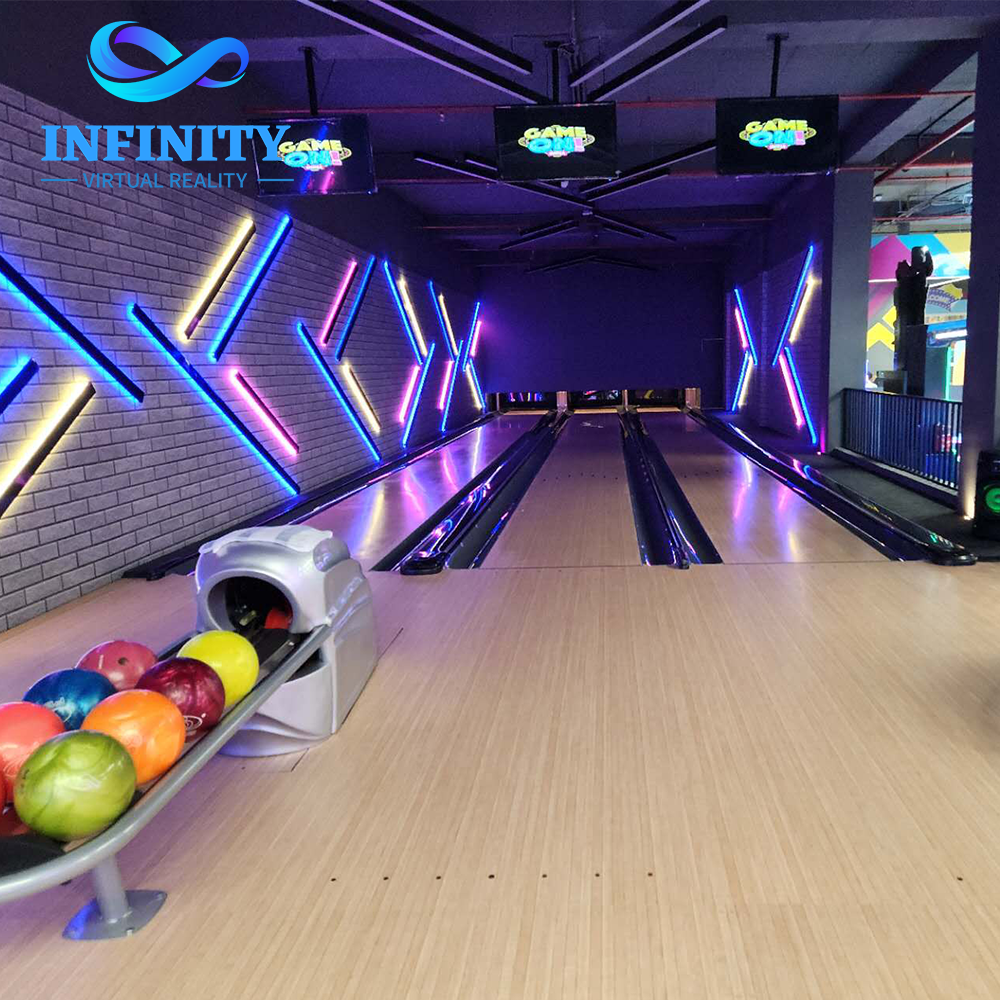
The Duckpin Bowling System from NextPlay is engineered specifically for venues that want the excitement of bowling without the massive footprint of a traditional 10-pin alley. At just 9.7 to 13 meters in length — roughly half the space of a standard lane — it fits into existing bar and restaurant layouts that would never accommodate full-size bowling. This is the product that single-handedly turned Marco's venue around.
What makes duckpin bowling different from traditional bowling? The pins are smaller, the balls are lighter (no finger holes needed), and players get three rolls per frame instead of two. This means each game lasts longer, which translates directly to more food and beverage sales per customer. Marco discovered that his average table check jumped from $18 per person (when he had pool tables) to $37 per person after installing duckpin bowling — because groups were staying 90 minutes instead of 30.
The installation process was remarkably straightforward. The system features a lower foundation height of just 20-23cm, which means Marco did not need to excavate or reinforce his existing floor. The sub-flooring uses premium materials engineered for commercial durability, and the whole setup was completed in four days by the NextPlay installation team. For a bar owner who cannot afford to close for weeks, this fast turnaround was critical.
Marco installed two duckpin lanes, occupying approximately 380 square feet of his total floor plan. He charges $32 per hour per lane during peak times (Thursday through Sunday evenings) and $22 per hour during off-peak hours. With an average utilization rate of 68% across both lanes, the duckpin installation alone generates approximately $8,900 per month in gross revenue. That is more than his entire venue used to make before the upgrade.
"I was ready to close the doors. The bank account was draining $1,200 a month and I had maxed out my credit line," Marco told me when I visited his venue in October 2024. "I found NextPlay through a bar owner group on Facebook, and the duckpin bowling system caught my eye because it fit in my space. I spent $34,000 on two lanes including installation, scoring displays, and seating. Within the first weekend, I made $1,800 just from lane rentals. By month three, my total venue revenue had doubled. The bowling brought in groups of friends, corporate teams, and birthday parties — people I never would have attracted with pool tables."
The impact on food and beverage sales was even more dramatic. "Before bowling, my average customer stayed 35 minutes and spent $14 on drinks. Now they stay 90 minutes minimum, and they order food because they are watching their friends bowl. My F&B revenue went from $3,200 a month to $7,800 a month just from the extended dwell time."
| Specification | Details |
|---|---|
| Lane Length Options | 9.7m to 13m (vs 26m for standard 10-pin) |
| Foundation Height | 20-23cm (lower than standard) |
| Ceiling Requirement | 2.8 meters minimum |
| Ball Size | Approximately 4.75 inches (no finger holes) |
| Pins Per Frame | 10 smaller pins, 3 rolls per frame |
| Scoring System | Automatic digital scoring with leaderboard display |
| Recommended Venue Types | Bars, hotels, boutique venues, small FECs |
| Installation Time | 3-5 days per pair of lanes |
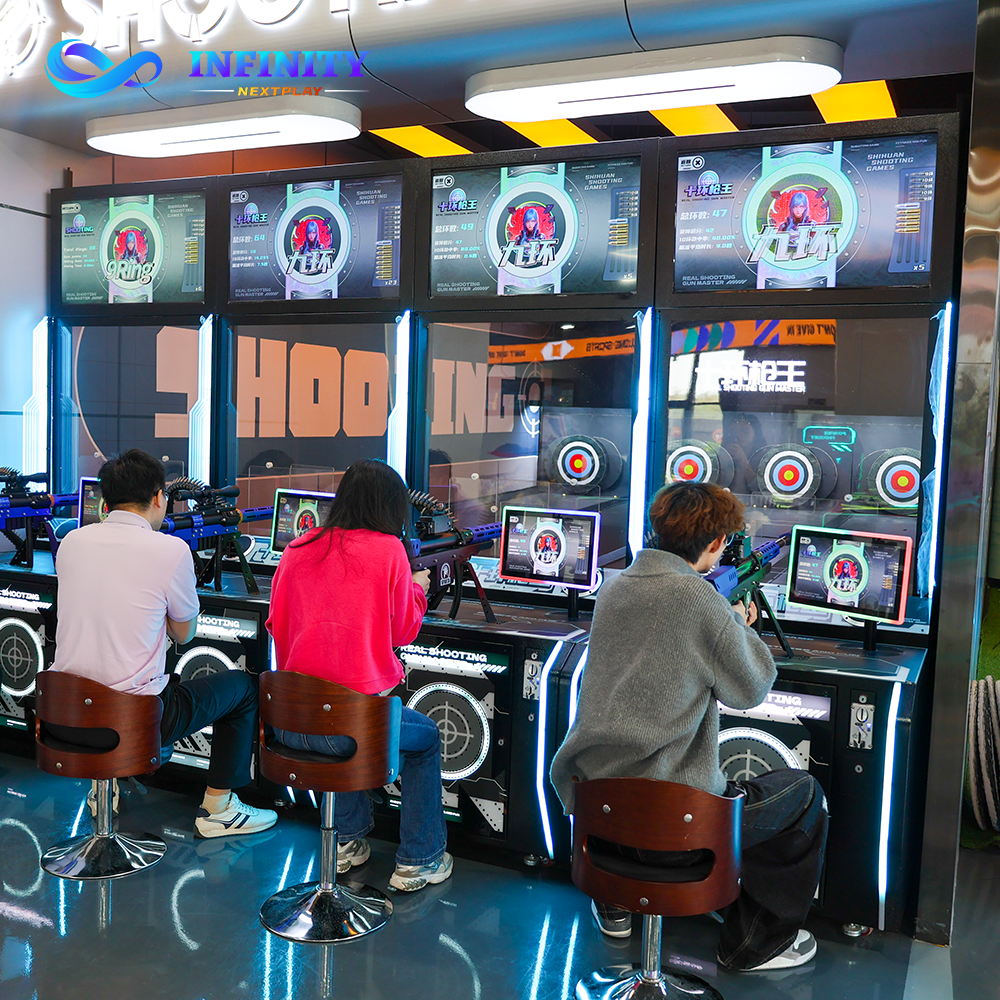
While duckpin bowling brought in the crowds, Marco needed a second attraction to keep customers engaged after their bowling session ended. He chose the Shooting Simulator Q4, and it turned out to be the perfect complement. The Q4 features a professional 10-ring scoring system with moving targets, a 39-inch top display for live leaderboards, and a fully automatic bullet loading system that eliminates the need for staff intervention during gameplay.
Here is what makes the Q4 different from a standard arcade shooting game: it is built for competitive social play. The top display shows real-time rankings, which means groups of friends can compete against each other and against the venue's all-time leaderboard. Marco started running weekly shooting tournaments every Tuesday night, charging $15 per entry with a $100 bar tab prize for the winner. These tournaments alone bring in 40-60 players every Tuesday, generating $600-$900 in entry fees plus an estimated $1,200 in food and beverage sales during the four-hour event.
The Q4 occupies just 120 square feet of floor space — roughly the footprint of a pool table — but generates substantially more revenue. Marco charges $12 for a 15-minute session or $40 for a full hour. With an average of 22 sessions per day across weekdays and weekends, the Q4 alone produces approximately $5,100 per month in gross revenue. When combined with the tournament revenue and the F&B uplift it drives, the Q4 contributes roughly $7,800 per month to the venue's total income.
The equipment itself is built for industrial durability. The alloy cabinet withstands heavy daily use, the moving target system operates reliably for thousands of hours, and the automatic bullet loading system means Marco's staff never has to manually reload between players. This is critical for a bar environment where staffing is already stretched thin — the Q4 runs itself while the bartender focuses on serving drinks.
"I was skeptical about the shooting simulator at first," Marco admitted. "I thought it was just another arcade game that would get old after a month. But the leaderboard system changed everything. People started coming back week after week to beat their friends' scores. I have a regular named Derek who has been here every Tuesday for six months straight trying to break the all-time record. He brings three or four friends every time, and they all buy food and drinks while they wait their turn."
"The Q4 cost me $18,500 installed. I made that back in tournament entry fees and session revenue alone within four months. But the real money is in the food and drinks — people who come for the shooting tournament stay an extra 90 minutes on average, and that translates to about $22 per person in additional F&B sales. On a busy Tuesday night with 50 tournament players, that is over $1,100 in extra bar revenue from a single attraction."
| Specification | Details |
|---|---|
| Scoring System | Professional 10-ring scoring with moving targets |
| Top Display | 39-inch LCD for live leaderboards |
| Touch Screen | 15.6-inch touch screen interface |
| Bullet System | Fully automatic bullet loading system |
| Audio System | Verbal score announcements + ambient sound |
| Cabinet Material | High-strength alloy for industrial durability |
| Floor Space Required | Approximately 120 sq ft (similar to a pool table) |
| Recommended Venue Types | Large FECs, clubs, team building venues, sports bars |
One of the most common questions I get from venue owners is: "If I can only afford one, which should I choose?" The answer depends on your venue type, but the data from Marco's bar provides a clear comparison. Below is a side-by-side breakdown of how each product performs in the same venue, under the same conditions, over a 30-day period.
| Metric | Duckpin Bowling (2 Lanes) | Shooting Simulator Q4 |
|---|---|---|
| Equipment Cost (Installed) | $34,000 | $18,500 |
| Floor Space Required | 380 sq ft | 120 sq ft |
| Peak Hourly Rate | $32/hour per lane | $40/hour per session |
| Daily Sessions/Average | 18 games per day | 22 sessions per day |
| Monthly Gross Revenue | $8,900 | $5,100 |
| F&B Uplift Per Month | $4,600 (extended dwell time) | $2,700 (tournament nights) |
| Total Monthly Contribution | $13,500 | $7,800 |
| Payback Period | 10-12 months | 8-10 months |
| Staffing Requirement | Minimal (automated scoring) | Zero (fully automatic) |
| Best For | Groups, families, casual social play | Competitive players, tournaments, team building |
The data tells a clear story: if you have the floor space, duckpin bowling delivers higher total revenue due to the dramatic F&B uplift from extended dwell time. But if space is limited, the Q4 offers a faster payback and requires zero staff intervention. The best strategy, as Marco discovered, is to install both — they serve different customer segments and complement each other perfectly. Bowlers who finish their game often migrate to the shooting simulator, and tournament players come early to bowl before competing.
Let us break down the complete financial picture. This is the actual data from Marco's venue over a 30-day period in early 2025, eighteen months after installation. These numbers are real — not projections or industry averages. If you are considering a similar setup, use this as your baseline and adjust for your local market conditions.
| Revenue/Cost Category | Monthly Amount | Notes |
|---|---|---|
| Duckpin Lane Revenue | $8,900 | 2 lanes, 68% utilization, $22-$32/hr |
| Shooting Q4 Session Revenue | $5,100 | 22 sessions/day avg, $12-$40/session |
| Tuesday Tournament Revenue | $2,400 | 4 Tuesdays, $15 entry, 50 players avg |
| F&B Revenue (Attraction-Driven) | $7,300 | $4,600 from bowling + $2,700 from Q4 |
| Total Gross Revenue | $23,700 | All sources combined |
| Rent (allocated) | $4,800 | 3,200 sq ft at $1.50/sq ft |
| Staff Payroll | $3,200 | 2 part-time bartenders + 1 floor manager |
| Equipment Maintenance | $420 | Routine maintenance, parts replacement |
| Utilities & Insurance | $1,100 | Electricity, water, liability insurance |
| Marketing | $600 | Social media ads, local SEO, flyers |
| F&B COGS | $2,920 | 40% of F&B revenue |
| Total Expenses | $13,040 | All operating costs |
| Net Profit Per Month | $10,660 | 45% profit margin |
With a total equipment investment of $52,500 ($34,000 for duckpin bowling + $18,500 for the Q4), Marco's payback period was approximately 5 months — significantly faster than the industry average of 12-18 months. This was driven by the unexpectedly high F&B uplift, which accounted for nearly 31% of total revenue. The lesson here is clear: when calculating ROI for entertainment equipment, you must factor in the food and beverage revenue that the equipment drives, not just the direct session revenue.
Every venue is different, but the principles that made Marco's bar successful are universal. Here is the exact step-by-step process he followed, distilled into actionable steps that you can apply to your own venue.
Before buying any equipment, measure your available floor space and identify which existing attractions are underperforming. Marco's audit revealed that his six pool tables occupied 600 square feet but generated only $1,400 per month combined. That is $2.33 per square foot — far below the $15-25 per square foot that duckpin bowling generates. Remove or relocate any attraction that produces less than $5 per square foot per month. This frees up space for higher-margin equipment and reduces maintenance costs.
If you have 350+ square feet available, start with Duckpin Bowling as your primary attraction. It generates the highest total revenue due to extended dwell time and F&B uplift. If space is tight (under 200 sq ft), start with the Shooting Simulator Q4 instead — it fits in the footprint of a pool table and offers a faster payback period. You can always add the second attraction later once the first one proves profitable.
Do not underprice your attractions. Marco initially charged $18/hour for duckpin bowling and raised it to $32/hour after seeing demand. His utilization rate actually increased because customers perceived higher value at the higher price point. For the Q4, charge per session (15-minute blocks) rather than per hour — this allows you to serve more players during peak times. Use tiered pricing: weekday off-peak at 60-70% of peak pricing, and weekend peak at a premium. Always offer a package deal that includes food and drinks to maximize per-customer spend.
Weekly tournaments are the single most effective marketing tool for this type of venue. Marco's Tuesday night shooting tournament brought in 50+ players every week. Pick a slow night (Tuesday or Wednesday), set a $15 entry fee with a $100 bar tab prize, and promote it heavily on social media. The tournament itself breaks even on entry fees, but the F&B revenue from players who stay to eat and drink generates $1,000+ per event. After three months of consistent tournaments, your venue becomes known as the competitive gaming destination in your area.
Both the duckpin bowling system and the Q4 are designed for minimal staff intervention. The bowling system uses automatic digital scoring, and the Q4 has a fully automatic bullet loading system. This means your staff can focus entirely on food and beverage service rather than operating equipment. Marco runs his entire venue with two part-time bartenders and one floor manager — total payroll of $3,200 per month. The key is to position your bar or kitchen area so that staff can monitor the attractions while serving customers, eliminating the need for dedicated game attendants.
The leaderboard system on the Q4 is a built-in marketing engine. Encourage players to take photos of their scores and post them on social media with a branded hashtag. Marco created a "Wall of Fame" next to the shooting simulator where he prints and posts the top 10 scores each month. This drives repeat visits — players come back to beat their previous scores and to see if they made the wall. For duckpin bowling, create a "Lane Champion" program where the team with the highest weekly score gets their name on a plaque above the lanes. These small investments in social proof cost almost nothing but drive significant repeat business.
Once your first two attractions are profitable, plan your third. Marco is now considering adding a Dart Machine X7 to his venue. The X7 supports global online matchmaking, which means players at his bar can compete against players at venues around the world. This creates a entirely new customer segment — serious dart enthusiasts who will travel to find a connected machine. Budget for expansion from day one: set aside 15% of your monthly profit toward your next equipment purchase, and you will have enough for a third attraction within 8-10 months.
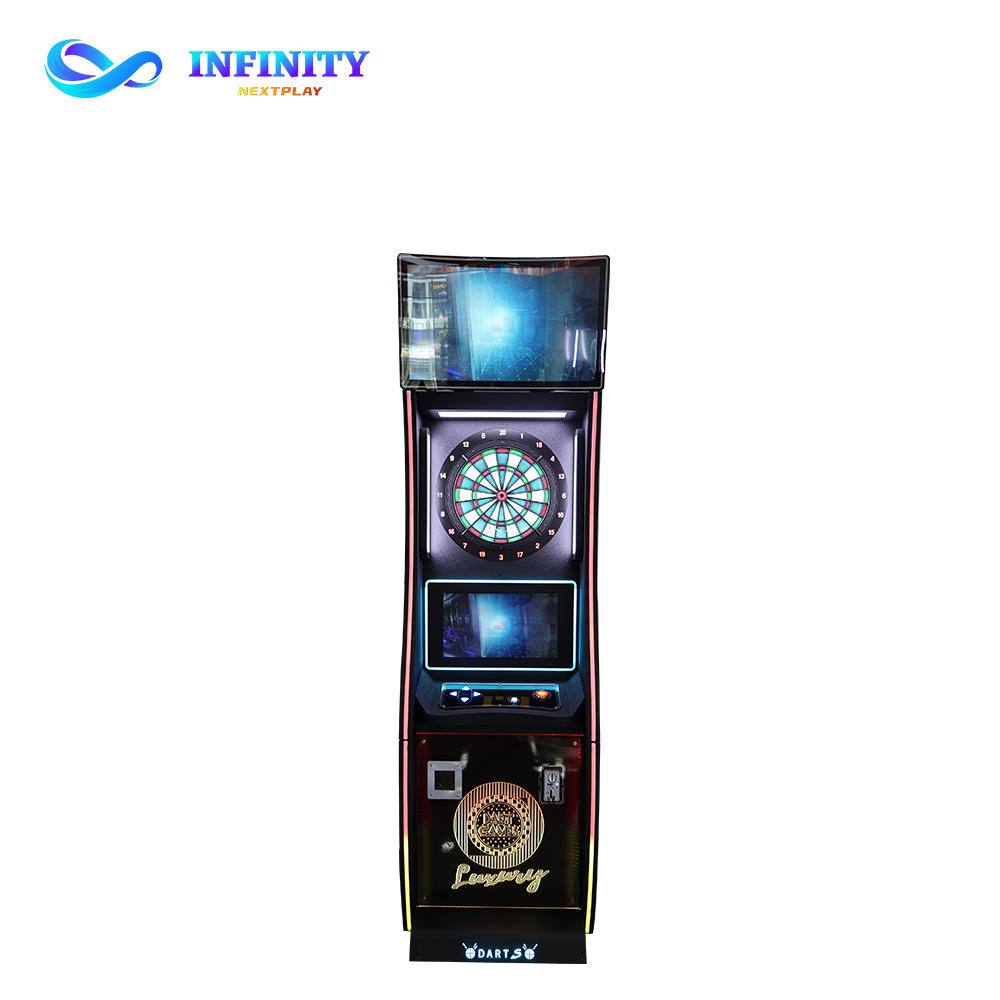
If you are planning a multi-attraction venue like Marco's, the Dart Machine X7 is the natural third attraction. As NextPlay's flagship competitive model, the X7 bridges the gap between traditional sports and e-sports with its global online matchmaking platform. Players log in, compete against opponents worldwide, and earn rankings that follow them across venues. This creates a loyalty loop that drives repeat visits — dedicated dart players will choose your venue specifically because it has a connected X7 machine.
The X7 is engineered for high-end clubs and professional gaming venues, but it works equally well in a sports bar environment. Its automatic scoring system eliminates disputes, the dual-screen setup creates a spectator experience that drives group bookings, and the online ranking system gives players a reason to come back week after week. At an equipment cost of approximately $6,800, the X7 typically pays for itself within 4-6 months in a venue that already has foot traffic from bowling and shooting attractions.
Each duckpin lane requires 9.7 to 13 meters in length and approximately 1.2 meters in width. For a two-lane setup, you need roughly 380 square feet of floor space. The foundation height is only 20-23cm, which means most existing commercial floors can accommodate it without excavation. The minimum ceiling height is 2.8 meters. If you are replacing pool tables, you likely already have enough space.
Yes. The Q4 features a fully automatic bullet loading system and verbal score announcements, which means it runs entirely self-service. Players pay at the machine (coin-operated or card reader), and the system handles everything else — loading, scoring, target movement, and leaderboard updates. The only maintenance required is periodic cleaning and occasional parts replacement, which takes less than 30 minutes per week.
Based on Marco's actual data, the combined duckpin bowling + Q4 setup paid for itself in approximately 5 months. This assumes a total investment of $52,500 and a net monthly profit of $10,660. However, your payback period will vary depending on your local market, pricing strategy, and utilization rates. Most venue owners see payback within 8-12 months, which is significantly faster than traditional arcade equipment (18-24 months).
The Q4 uses rubber bullets and is classified as an entertainment simulator, not a firearm. In most jurisdictions, no special license is required beyond your standard business and entertainment permits. However, regulations vary by location, so we recommend checking with your local municipal office. NextPlay provides all necessary documentation and compliance certificates with every unit shipped.
Duckpin bowling installation takes 3-5 days per pair of lanes. The Q4 can be installed in a single day. Most venues close for 3-5 days during installation and reopen with the new attractions fully operational. NextPlay's installation team handles everything from sub-floor preparation to final calibration, so you do not need to hire contractors separately. The equipment comes with a 12-month hardware warranty and lifetime software support.
Get a free 3D layout for your space. No commitment required.